White Label SEO Reseller vs. Private Label: Which Model Fits Your Agency?
Rohit Nandan
Founder & Lead Digital Marketing Consultant
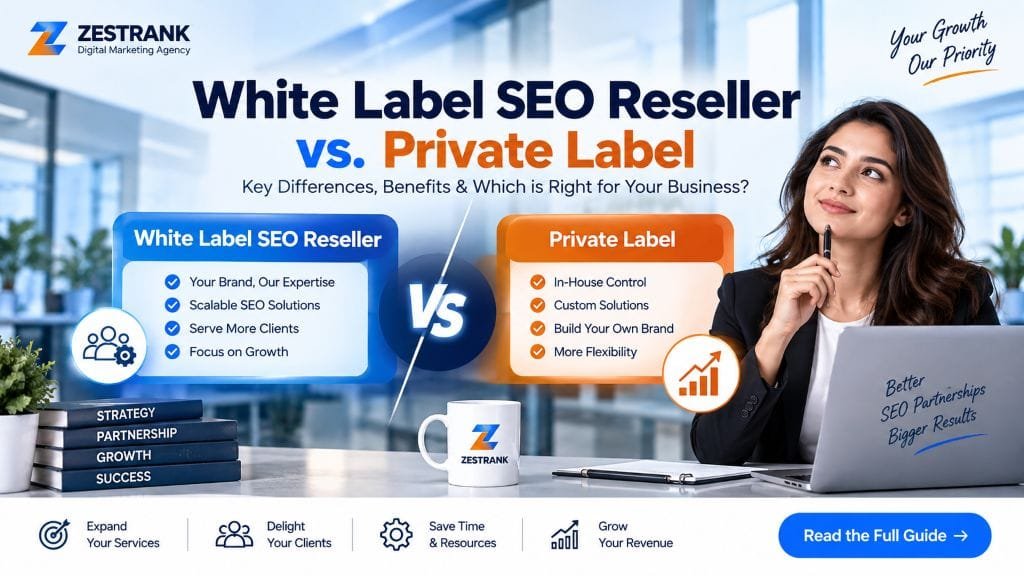
Quick answer: “White label SEO” gets used loosely to describe two different models. A reseller model typically passes your client’s project along with minimal agency involvement — closer to a middleman relationship. A private label model works as a silent extension of your own team: you keep the client relationship and strategic input, while execution happens under your brand with your oversight. The distinction affects how much control, risk, and quality assurance you actually retain — ask which model a provider uses before signing.
Why the Terminology Confusion Costs Agencies {#why-it-matters}
Search “white label SEO” and you’ll find providers using the term for wildly different arrangements — some are closer to a private label manufacturing relationship, where you retain the brand and strategic control while a partner executes; others are closer to a reseller arrangement, where you’re essentially forwarding client work to a third party with limited oversight. Agencies that don’t know which one they’re buying often find out the hard way — usually when quality control turns out to be thinner than expected, or when they discover exactly how many hands actually touched the client’s account.
What “White Label SEO Reseller” Actually Means {#reseller-defined}
In a pure reseller model, your role is primarily to sell and mark up a pre-packaged service. The provider often has standardized deliverables with limited customization, communication tends to flow through account managers who aren’t doing the execution themselves, and you may have limited visibility into who’s actually performing the work — which sometimes means a further layer of subcontracting you can’t see. This model can work fine for very standardized, low-complexity SEO needs, but it offers less room for strategic input on client-specific goals.
What “Private Label SEO” Actually Means {#private-label-defined}
A private label (or “true white label”) partnership functions more like an extension of your internal team. You retain the client relationship and set strategic direction; the partner executes technical work, content, and link building under your brand; and deliverables go through your review before reaching the client. The provider typically works within your existing tools and reporting stack rather than forcing you onto theirs, and communication happens directly with the people doing the work — not through an extra layer of account management.
Side-by-Side: Reseller vs. Private Label {#side-by-side}
| Factor | Reseller Model | Private Label Model |
|---|---|---|
| Client relationship ownership | Often shared or unclear | Fully retained by your agency |
| Strategic input | Limited, standardized packages | High — customized to client goals |
| Who executes the work | Often unclear, possibly subcontracted further | Named team, directly accountable |
| Communication | Through account manager, indirect | Often direct with the execution team |
| Reporting tools | Provider’s proprietary dashboard | Works inside your existing stack |
| QA before delivery | Varies, often minimal | Typically multiple internal review rounds |
| Best suited for | High-volume, low-complexity needs | Client-specific strategy and niche verticals |
Questions That Reveal Which Model You’re Actually Getting {#reveal-questions}
A provider won’t always volunteer which model they operate under, so it helps to ask directly: Is the account manager I’m speaking with the person doing the work, or is it subcontracted further? And: Can I see a sample deliverable before committing? These two questions alone usually surface which model you’re dealing with faster than anything in a sales pitch. For the full vetting checklist, see 12 Questions to Ask Before Hiring a White Label SEO Partner.
Which Model Fits Your Agency’s Stage {#which-fits}
Newer agencies with mostly standardized, low-complexity client needs (basic local SEO, single-location businesses) can sometimes get by with a reseller arrangement, where the priority is speed and low cost per unit. Agencies serving niche or YMYL industries — legal, healthcare, finance — or agencies whose value proposition rests on strategic customization generally need the private label model, where oversight and specialization matter more than volume pricing.
Red Flags Specific to Each Model {#red-flags}
Reseller red flags: no visibility into who executes the work, resistance to sharing sample deliverables, communication exclusively through scripted account managers, and pricing based purely on volume discounts rather than deliverable quality.
Private label red flags: claims of “full private label” service without a clear answer on who’s actually doing execution, no defined QA process before deliverables reach you, and reluctance to let you review work before it goes to your client.
Where to Go Next {#where-to-go-next}
ZestRank operates on the private label model described above — see exactly how that works, including trial terms and pricing, on our White Label SEO Services for USA Agencies page. If you’re also weighing this against building an internal team, White Label SEO vs. In-House SEO: The True Cost Comparison breaks down the numbers on both sides.
FAQs {#faqs}
Q: Is “white label SEO” always the same as reselling? A: No — “white label” is often used loosely to describe both reseller and private label arrangements, which differ significantly in how much oversight and strategic input you retain.
Q: How can I tell which model a provider actually uses? A: Ask who’s directly executing the work, whether you can see sample deliverables, and what their QA process looks like before something reaches your inbox. Vague answers to any of these are a signal worth taking seriously.
Q: Which model is better for agencies serving healthcare or legal clients? A: Private label, generally — YMYL industries require closer strategic oversight and content accuracy than a standardized reseller package typically provides.
About the Author: Rohit Nandan
Founder & Lead Digital Marketing ConsultantRohit Nandan is ZestRank's Founder & Lead Digital Marketing Consultant and YouTube SEO Expert, with over 15 years of experience diagnosing and running search campaigns for businesses across Delhi NCR. He personally reviews ZestRank's client projects, with deep expertise in technical SEO infrastructure and YouTube optimization. Have a question about this post? Message Rohit directly on WhatsApp.
Free Consultation
Ready to see how these exact parameters can be configured to expand your physical business discovery indices?
Request Strategy Call WhatsApp Strategist