Generative Engine Optimization (GEO): The Complete 2026 Guide for Indian Businesses
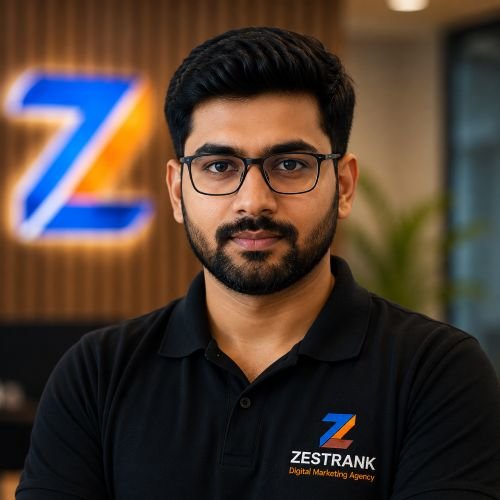
Rohit Nandan
Founder & Lead Digital Marketing Consultant
Quick answer: Generative Engine Optimization (GEO) is the practice of structuring content so AI-powered search tools — Google AI Overviews, ChatGPT, Gemini, Perplexity, Bing Copilot, and Claude — are more likely to cite or directly use it when generating answers. It builds on traditional SEO but prioritizes clear definitions, structured answers, and genuine source authority over keyword density and backlink volume alone. The term was coined in a 2023 Princeton/Georgia Tech/Allen Institute/IIT Delhi research paper, which found that the strongest optimization strategies produced up to a 40% relative improvement in AI-generated answer visibility compared to unoptimized content.
Search is splitting into two parallel systems. The first is the traditional list of blue links you’ve spent years optimizing for. The second — and increasingly dominant — is the AI-generated answer layer: the direct responses that ChatGPT, Google AI Overviews, Gemini, and Perplexity produce before a user ever reaches a website.
Industry analyses report that AI Overviews now appear on a substantial and growing share of searches, and that click-throughs to publisher websites drop meaningfully when they fire — with some reports placing zero-click search rates well above half of all Google queries, climbing further specifically on AI Overview-triggered searches. The exact figures vary by study and dataset, but the direction is consistent across every source: fewer clicks are reaching websites directly, and more answers are being consumed inside the AI layer itself.
GEO is the discipline of making sure your content is the source these AI systems choose to pull from. In 2026, it’s becoming as important as traditional SEO for any business that wants visibility in both search layers simultaneously.
What’s the Difference Between SEO, AEO, and GEO? {#seo-aeo-geo}
These three disciplines are layered — not competing:
| Factor | Traditional SEO | AEO | GEO |
|---|---|---|---|
| Goal | Rank in organic search results | Win featured snippets, voice answers, AI Overview extraction | Get cited inside full AI-generated answers |
| Primary signals | Keywords, backlinks, technical health | Q&A structure, schema, direct-answer formatting | Entity authority, statistical density, third-party citations, extractable passages |
| Success metric | Ranking position, organic clicks | Featured snippet wins, AI Overview inclusion | Citation/mention within AI-generated answers across ChatGPT, Gemini, Perplexity |
| Content style | Optimised for skimming and intent matching | Optimised for direct extraction | Optimised for trust, citation-worthiness, and generative synthesis |
SEO is the foundation. AEO builds on it. GEO sits at the top — focused on whether an AI model trusts your brand enough to mention it by name when generating an answer.
GEO doesn’t replace SEO. Strong technical and on-page SEO fundamentals remain necessary — and are actually a prerequisite for GEO. Industry analyses commonly report that a large majority of AI Overview citations come from pages outside Google’s traditional top 10 results, meaning ranking position alone isn’t the winning condition — but being cited in an AI Overview is also reported to lift downstream organic clicks meaningfully compared to similar uncited pages. The two systems appear to reinforce each other when both are optimised, even if the precise multipliers vary across the studies reporting them.
Why GEO Matters — Especially for Indian Businesses in 2026 {#india}
The scale of the AI search shift in India specifically is significant and accelerating:
- Google AI Overviews now appear across a substantial share of Google search results globally, and India is one of the highest-penetration markets for both Google and ChatGPT
- India is widely reported as OpenAI’s second-largest ChatGPT market by user base, after the US
- AI tool adoption among Indian SMBs has risen sharply since 2024, alongside a corresponding rise in the share of marketing budgets allocated to AI-related tools
- Businesses implementing GEO strategy early have reported brand appearances in ChatGPT and Gemini responses within weeks, not months, for niche-specific queries
The businesses investing in GEO and AEO now are building a competitive advantage that will be difficult for late movers to close.
How AI Search Tools Actually Select Sources — The RAG Mechanism {#rag}
Understanding why some content gets cited and other content gets skipped requires understanding how AI search tools work technically. Most generative search engines — including ChatGPT’s web search mode, Perplexity, and Google AI Overviews — use a two-stage process called RAG (Retrieval-Augmented Generation):
Stage 1 — Retrieval: The system searches an index of web content to find documents relevant to the user’s query. This stage behaves similarly to traditional search — authority, relevance, and freshness all matter.
Stage 2 — Generation: The AI model reads the retrieved documents and synthesizes a new, coherent answer by extracting and combining the most relevant passages. This stage is where GEO optimization determines whether your content gets cited or passed over.
At Stage 2, AI systems favor:
- Extractable passages — complete, standalone answers within your content that can be lifted without surrounding context
- Statistical and factual density — content containing verifiable, sourced data is treated as more authoritative than unsupported claims
- Topical consistency — content that clearly covers one topic deeply rather than touching many topics superficially
- Structural clarity — numbered steps, tables, and FAQ sections that AI can parse and reformat easily
Platform-by-Platform GEO Strategy {#platforms}
Each major AI platform has distinct retrieval characteristics. A single-platform strategy won’t work in 2026.
Google AI Overviews
Google’s AI Overview system retrieves web pages in real time, synthesizes a short answer, and typically links to several source pages alongside it. It heavily weights pages already ranking well in traditional search — making technical SEO a genuine prerequisite here, more so than on other platforms. Schema markup, E-E-A-T signals, and Core Web Vitals all directly influence AI Overview eligibility.
GEO priority: On-page structure, technical SEO health, and schema markup (FAQPage, HowTo, Article, LocalBusiness as appropriate). Our On-Page SEO Checklist covers exactly what this looks like at the page level, including the AI-readability items that feed directly into this.
ChatGPT (Web Search Mode)
ChatGPT’s web search mode uses Bing’s index as its primary retrieval layer. Pages well-indexed by Bing — not just Google — have a citation advantage here. ChatGPT tends to prefer pages with strong structural clarity, direct-answer formatting, and established brand mentions in its training data.
GEO priority: Bing SEO parity with Google, strong brand entity presence, and direct-answer content structure.
Perplexity
Perplexity operates its own web crawler and explicitly prioritizes sources it considers trusted and authoritative — giving significant weight to pages with strong backlink profiles, clear authorship, and external citation presence. It surfaces sources more visibly than other platforms, making it one of the more transparent AI platforms for tracking citation performance.
GEO priority: Backlink authority, external citation footprint (Reddit, industry publications, review platforms), and clear author expertise signals.
Google Gemini
Gemini draws from Google’s broader web index and knowledge graph, making Google Business Profile completeness and entity consistency across Google’s ecosystem important factors — particularly for local and brand queries.
GEO priority: Google Knowledge Graph entity optimization, GBP completeness, and consistent brand mentions across Google’s ecosystem.
Bing Copilot
Copilot uses Bing’s index and heavily weights content structured for Microsoft’s AI Overviews format. It shows strong citation performance for content with clear, quotable passages and strong schema implementation.
GEO priority: Schema markup, Bing Webmaster Tools indexing, and quotable passage formatting.
Claude, DeepSeek & Emerging Platforms
Claude (Anthropic) and DeepSeek are increasingly used for research-oriented queries. Both tend to favor long-form, structured content with clear expertise signals. As these platforms grow in India’s market, monitoring citation presence across them becomes increasingly important.
GEO priority: E-E-A-T signals, research-quality content, and clear topical depth.
How to Optimize Content for GEO — 7 Tactics {#tactics}
1. Open With a Direct, Quotable Answer
Don’t bury the definition or core answer three paragraphs in. Lead with a tight, 2-3 sentence answer that could be lifted directly into an AI response — this is the single highest-leverage GEO tactic available. Every ZestRank blog post uses this structure deliberately.
2. Use Clear Structural Elements
Numbered steps, comparison tables, and FAQ sections are easier for AI systems to parse and extract accurately than long, unstructured prose. Structure content the way you’d want an AI assistant to be able to summarize it.
3. Include Verifiable Statistics With Source Attribution
The Princeton/Georgia Tech/Allen Institute/IIT Delhi study that formalized GEO — Aggarwal et al., “GEO: Generative Engine Optimization,” arXiv:2311.09735 — found that adding relevant, sourced statistics and quoted authoritative sources were among the highest-impact strategies tested, producing up to a 40% relative visibility improvement over unoptimized baselines. Reference real studies, name your sources within the content, and update statistics regularly — AI systems appear to weight stale, unsourced claims less favorably than current, attributed ones.
4. Disambiguate Ambiguous or Emerging Terms
If a term has multiple meanings or isn’t fully standardized, explicitly say so and clarify which meaning your content addresses. AI systems need to resolve which definition applies before they can confidently cite a source. Being the clearest source on an ambiguous topic is one of the fastest ways to earn early citations.
5. Build Genuine Topical Depth Across a Content Cluster
A single well-optimized page helps, but a cluster of interlinked, genuinely thorough content on a topic signals stronger overall authority to both traditional search engines and AI systems cross-referencing multiple pages on a subject. Original research, tools, and answer-first content are widely reported to outperform generic educational articles in GEO citation rate — depth and originality matter far more than volume.
6. Build Your Third-Party Citation Footprint
A meaningful share of what AI models cite about your brand comes not from your own website, but from external sources AI already trusts: Reddit communities, review platforms, industry roundup articles, and authoritative directories. Getting your brand mentioned on sources AI platforms already trust is often faster to citation impact than optimizing your own pages alone.
7. Keep Technical SEO Fundamentals in Place
AI retrieval systems appear to weight recent content more heavily for time-sensitive queries — articles with visible “Last Updated” signals, current statistics, and fresh examples tend to outperform stale evergreen content for fast-moving topics. Crawlability, fast load times, proper indexing, and freshness signals remain prerequisites for GEO, not separate concerns. Our Free SEO Audit Checklist now includes a dedicated AI search readiness section covering exactly this.
How to Measure GEO Results {#measuring}
There’s no universal dashboard for AI citations the way Search Console shows organic impressions — yet. But measurement is possible and improving:
Manual citation checking: Ask ChatGPT, Gemini, Perplexity, and Copilot the exact questions your content is meant to answer. Note whether your site is referenced. Do this monthly for your top 10 target queries and track changes over time.
Referral traffic monitoring: Google Analytics 4 increasingly distinguishes referral traffic from AI chat platforms (ChatGPT, Perplexity) as identifiable sources. Monitor these separately from other referral traffic.
Branded search uptick: AI citation exposure often drives branded search increases even without direct click-through — users who see your brand cited by AI search for it directly. Watch for unexplained branded search volume growth in Search Console.
Share of Voice in AI answers: Some platforms, and a growing set of dedicated third-party tools, now offer structured AI citation tracking. As of 2026, this space is evolving rapidly and worth revisiting periodically.
The ROI question: AI visibility dashboards can’t answer the ROI question on their own. Track the metrics that connect AI visibility to business outcomes — specifically, whether leads or conversions are attributable to branded searches or direct traffic that followed AI citation exposure.
Common GEO Misconceptions {#misconceptions}
“GEO replaces SEO” — It doesn’t. GEO is an additional layer on top of fundamentally sound SEO. Technical SEO is a prerequisite, not an alternative.
“Just adding more keywords will improve GEO performance” — AI systems evaluate clarity and structure, not keyword density. Over-optimising for keywords actively hurts the readability and extractability that GEO rewards.
“There’s a single trick to get cited” — Citation depends on genuine clarity, accuracy, and structure across your content as a whole, plus your third-party citation footprint. No single formatting hack substitutes for these.
“Only big brands get cited” — Reports from businesses implementing GEO strategy properly describe achieving AI citations within weeks for niche-specific queries — often outperforming larger but less specifically-structured competitors on narrow topics.
“AI citations don’t drive traffic” — Multiple industry analyses report that AI Overview citations lift downstream organic clicks compared to similar pages without citation, even when the AI answer itself satisfies the immediate query. Being cited increases total search visibility across both layers, not just within the AI answer itself.
Final Thoughts
GEO represents a genuine, permanent shift in how search visibility works — not a trend or a short-term experiment. Traditional SEO hasn’t shrunk — but the businesses building GEO capability on top of strong SEO foundations are building a compounding advantage that becomes harder to close over time.
The underlying principle hasn’t changed: be the clearest, most useful, most trustworthy source on a topic. GEO just adds a new surface — AI-generated answers — where that principle now pays off.
This connects directly to our piece on ghost impression keywords — both topics point to the same 2026 reality: traditional ranking position alone no longer guarantees traffic.
Want your content and entity footprint optimised for AI citation?
ZestRank offers dedicated AI Search Optimization services — GEO, AEO, and LLM SEO built specifically for Delhi NCR businesses and Indian brands wanting visibility across ChatGPT, Gemini, Perplexity, and Google AI Overviews. Get a free AI visibility audit and we’ll show you exactly which AI platforms are citing your competitors instead of you.
Frequently Asked Questions {#faqs}
What is Generative Engine Optimization (GEO)?
GEO is the practice of structuring your content, entity footprint, and online authority so AI-powered search tools — ChatGPT, Google AI Overviews, Gemini, Perplexity, Bing Copilot, and Claude — cite and recommend your content when generating answers. The term was coined in a 2023 Princeton/Georgia Tech/Allen Institute/IIT Delhi study, which found the strongest tested strategies produced up to a 40% relative improvement in AI-generated answer visibility.
Is GEO the same as AEO (Answer Engine Optimization)?
The terms overlap significantly and are often used interchangeably. The most useful distinction: AEO is a subset of GEO focused specifically on Google’s answer surfaces (featured snippets, AI Overviews, voice search). GEO is the broader discipline covering all generative AI platforms including ChatGPT, Perplexity, Gemini, and Claude. Every AEO tactic is a GEO tactic — but not every GEO tactic is AEO.
Does AI Search Optimization replace traditional SEO?
No. Technical SEO is a prerequisite for GEO, not an alternative to it. Strong crawlability, fast load times, backlink authority, and proper indexing all increase your probability of AI citation. GEO extends your visibility from Google’s ranking system into the AI answer layer — both working together is more effective than either alone.
How does GEO work for small businesses and startups in India?
Small businesses often have a citation advantage over larger competitors on niche-specific queries, because being the most specific, clearest source on a narrow topic often outperforms a large brand’s generic coverage of the same subject. Indian SMBs implementing proper GEO strategy have reported achieving AI citations within weeks for niche-specific queries, including in competitive categories like food, professional services, and local retail.
Which AI platforms should I prioritize for GEO in India?
For most Indian businesses, prioritize in this order: (1) Google AI Overviews — highest query volume and most relevant for local searches; (2) ChatGPT — India’s largest AI chat user base; (3) Perplexity — most transparent citation tracking, growing research-use adoption; (4) Gemini — important for entity and Google ecosystem integration. Claude and Bing Copilot are worth monitoring but lower priority for most Indian markets currently.
How long does GEO take to show results?
Early citation appearances for low-competition, niche-specific queries can appear within a few weeks with proper optimization. Competitive category terms typically require 3-6 months of consistent content, entity optimization, and citation-building work. Unlike paid ads, AI citations compound over time — early investments in GEO continue generating visibility returns without additional ongoing spend.
Can I measure whether my content is being cited by AI tools?
Yes — manually by querying ChatGPT, Perplexity, Gemini, and Copilot with the exact questions your content answers and noting whether your site is referenced. Monitor AI-specific referral traffic in GA4, watch for branded search upticks in Search Console, and track citation presence monthly for your key target queries. Dedicated AI citation tracking tools are also emerging rapidly in 2026.
What is RAG and why does it matter for GEO?
RAG stands for Retrieval-Augmented Generation — the two-stage process most AI search engines use. Stage 1 retrieves relevant documents from a web index (similar to traditional search). Stage 2 generates a new answer by extracting and combining passages from those documents. GEO optimization targets Stage 2 — ensuring your content contains clear, extractable passages that AI systems can confidently synthesize into their answers.
What did the original Princeton GEO study actually find?
The 2023 paper “GEO: Generative Engine Optimization” (Aggarwal et al., arXiv:2311.09735, presented at KDD 2024) tested nine content optimization strategies across a 10,000-query benchmark. The strongest strategies — primarily adding cited quotations and relevant statistics — produced up to a 40% relative improvement on the paper’s visibility metric compared to unoptimized content. It did not report a flat “3x more citations” figure; that specific framing is a common misquote circulating in secondary SEO commentary.
About the Author: Rohit Nandan
Founder & Lead Digital Marketing ConsultantRohit Nandan is ZestRank's Founder & Lead Digital Marketing Consultant and YouTube SEO Expert, with over 15 years of experience diagnosing and running search campaigns for businesses across Delhi NCR. He personally reviews ZestRank's client projects, with deep expertise in technical SEO infrastructure and YouTube optimization. Have a question about this post? Message Rohit directly on WhatsApp.
Free Consultation
Ready to see how these exact parameters can be configured to expand your physical business discovery indices?
Request Strategy Call WhatsApp Strategist