YouTube Semantic SEO in 2026: The Complete Guide to a 100/100 VidIQ Score
Rohit Nandan
Founder & Lead Digital Marketing Consultant
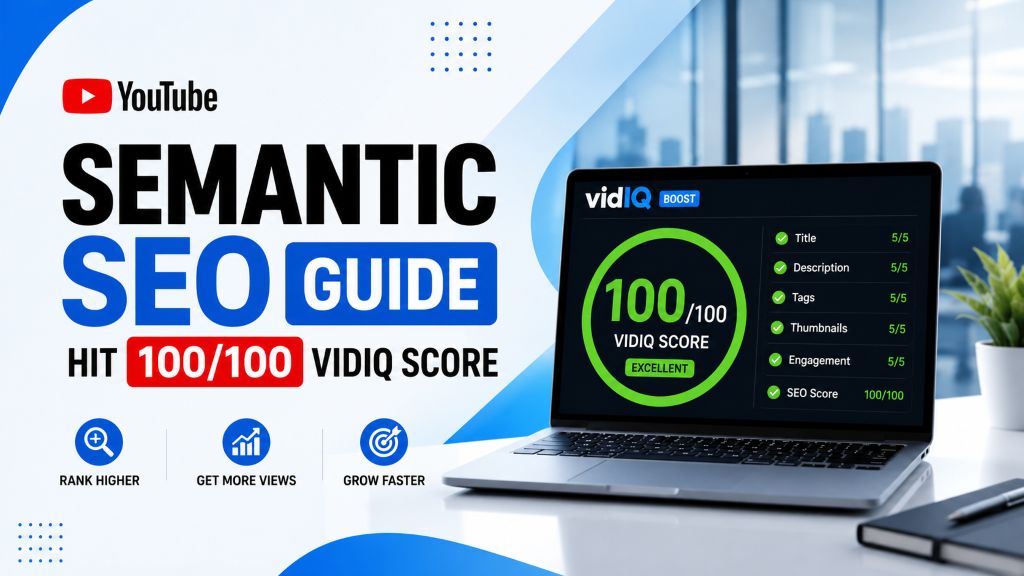
Quick answer: A 100/100 VidIQ score in 2026 comes from combining semantic metadata (a keyword-aligned title, description, and spoken transcript) with strong click-through rate and audience retention — metadata gets you discovered, but CTR and watch time are what YouTube’s algorithm actually weighs most heavily when deciding whether to keep ranking you.
Uploading a beautifully produced video to YouTube and hoping the algorithm finds it is a guaranteed way to get zero views. In 2026, YouTube is no longer just a video-sharing platform — with more daily searches than Google in many categories, it’s a highly sophisticated, AI-driven search engine in its own right.
To rank at the top of the feed and capture high-intent buyers, you need to stop guessing and start engineering your uploads. This guide breaks down the mechanics of YouTube semantic SEO, what actually drives a 100/100 VidIQ score, and how to turn passive viewers into leads.
Why Standard YouTube Tags No Longer Work {#why-tags-fail}
For years, creators relied on stuffing the “Tags” box with every conceivable keyword variation. Today, YouTube’s own guidance confirms tags play a minimal role in discovery — the algorithm has moved well past basic text matching.
The Shift to Natural Language Processing (NLP)
Google and YouTube now rely on Natural Language Processing to understand context, intent, and relevance. The algorithm doesn’t just read what you type into the description box — it “listens” to what you say and “watches” what happens on screen. If your metadata doesn’t align with your video’s actual spoken and visual content, rankings suffer regardless of how well the tags are written.
Unpacking YouTube Semantic SEO {#semantic-seo}
Semantic SEO means building deep topical relevance around a central concept rather than repeating one target keyword. Here’s how to execute it.
How the Algorithm Reads Your Spoken Transcripts
YouTube’s auto-captioning is highly accurate, and every spoken word gets transcribed and indexed. To use this well:
- Say your target keywords clearly within the first 15 seconds of the video.
- Provide contextual depth with industry-specific terminology throughout the script — a video about “Digital Marketing” should naturally include semantic terms like “conversion funnels,” “ROAS,” and “organic indexing.”
- Upload your own caption or subtitle file rather than relying only on auto-captions. Accurate, human-reviewed captions are more reliably indexed, improve accessibility, and are associated with meaningfully higher average watch time in creator-platform research — a real ranking lever, not just an accessibility nicety.
Structuring Your Video File Metadata Before Uploading
SEO begins before the video touches the internet.
- File naming: Never upload a file named
Final_Render_V3.mp4. Rename it to your target keyword, hyphen-separated (e.g.,youtube-semantic-seo-guide-2026.mp4). - Details properties: On your computer, right-click the file, open properties/details, and populate the Title, Subtitle, and Tags fields with your target search queries before uploading.
The Real Ranking Factors: CTR and Retention Come First {#ranking-factors}
Here’s the part a metadata-only approach misses: click-through rate and audience retention are the two dominant signals in YouTube’s 2026 algorithm — more influential than keyword placement alone. A video that gets clicked but loses viewers in the first 30 seconds actively hurts your channel’s algorithmic standing, no matter how well-optimized the title and description are.
This means:
- A 1,000-view video with strong retention can outrank a 100,000-view video with weak retention. Optimize for people finishing (or rewatching) your video, not just clicking on it.
- Metadata gets you the impression; content quality earns the ranking. Semantic SEO and a perfect VidIQ score make you discoverable — they don’t substitute for a video that actually holds attention.
- Treat CTR and retention as your primary metrics in YouTube Studio analytics, and treat VidIQ score as a supporting diagnostic, not the end goal itself.
The Blueprint for a 100/100 VidIQ SEO Score {#blueprint}
VidIQ is the industry-standard tool for measuring YouTube SEO strength. Hitting a 100/100 score takes a calculated balance of keyword placement and genuine topical depth.
Finding Real Keywords for Free
Before optimizing anything, start typing your topic into YouTube’s search bar and note the autocomplete suggestions — these are real, high-intent searches people are actively typing, and they’re typically less competitive than broad head terms. VidIQ’s own keyword tools and TubeBuddy build on this same signal with search volume and competition scoring if you want a deeper, data-backed view.
Optimizing the Title-to-Description Keyword Ratio
- The title: Keep it under 60 characters to avoid truncation, and place your primary keyword within the first 40 characters — YouTube’s algorithm weights early words more heavily, and it matters for mobile truncation too (e.g., “YouTube Semantic SEO: The Ultimate 2026 Strategy”).
- The description: The first 150 characters must read as a natural, complete sentence containing your primary keyword and a strong secondary keyword — this is the preview text shown before “Show more.”
- The body: Write a 200–300 word mini-blog post summarizing the video. Don’t list keywords — write comprehensive paragraphs using natural semantic variations of your topic.
- Hashtags: Add 2–3 relevant hashtags above the title and within the description — YouTube displays the first few directly above your video title in search results, adding another visible relevance signal.
Utilizing Chapter Timestamps for Google Universal Indexing
Adding structured timestamps to your description is a significant ranking signal.
- Start your first timestamp at exactly
00:00. - Use keyword-rich chapter names. Instead of
02:15 - Tips, write02:15 - How to Get a 100/100 VidIQ Score. Correctly formatted chapters frequently appear as “Key Moments” directly in Google’s universal search results, doubling your exposure beyond YouTube itself.
Don’t Skip Shorts or Playlists {#shorts-playlists}
Two commonly overlooked levers that a metadata-only strategy misses entirely:
- YouTube Shorts use different ranking signals than long-form video — audio choice, hashtags, and hashtag-search combinations matter more than traditional title/description optimization. Don’t reuse your long-form keyword strategy for Shorts; treat them as a separate, trend-and-audio-driven system.
- Playlists extend session watch time, which YouTube’s algorithm rewards. Grouping related videos into a themed playlist keeps viewers on your channel longer after one video ends, directly supporting the retention signals covered above.
Driving Conversion: From Viewers to Leads {#conversion}
High rankings and views are vanity metrics unless they accelerate revenue. Engineer your video to drive action.
Setting Up High-CTR Custom Thumbnails
CTR tells YouTube whether your video is actually relevant to the searcher, making this one of the two ranking factors that matter most (see above).
- Contrast and legibility: High-contrast colors, mobile-readable text.
- The 3-word rule: Keep thumbnail text to three or four impactful words that complement — not exactly duplicate — the title.
- Human element: Thumbnails featuring a human face with a clear expression consistently outperform text-only graphics.
For a deeper breakdown of thumbnail and title formulas specifically, see our companion guide on YouTube Thumbnail & Title Strategies That Increase CTR.
Routing Traffic from Descriptions to Your WhatsApp Pipeline
Remove friction from conversion. Pin a comment and use the top of your description for a clear, trackable CTA. Instead of routing to a complex homepage, drop a direct WhatsApp link or a single-intent landing page so interested prospects can start a conversation the moment your video solves their problem. Pair this with end screens and cards pointing to your next-best video or playlist — this keeps viewers inside YouTube longer (supporting retention) before they ever leave for WhatsApp.
Common Mistakes to Avoid
- Treating tags as the primary discovery mechanism — they carry minimal weight in 2026
- Optimizing metadata while ignoring retention — a well-tagged video with a weak hook still won’t rank
- Using the same keyword strategy for Shorts and long-form content
- Relying only on auto-captions instead of uploading a reviewed caption file
- Skipping playlists, hashtags, and end screens — all free, easy wins left on the table
Scale Your Channel with Delhi’s YouTube SEO Experts
Mastering algorithmic indexing, script optimization, and engagement retention takes time away from actually running your business. If you’re ready to stop guessing and treat your channel as a predictable revenue pipeline, partner with ZestRank’s YouTube SEO services in Delhi. We manage complete channel audits, implement 100/100 VidIQ metadata frameworks, and engineer videos around the retention and CTR signals that actually drive rankings. As video results increasingly surface inside Google’s AI Overviews and chat-based search, our AI Search Optimization service also covers making your video content discoverable there.
New to a channel entirely? Start with our guide on How to Get Your First 1,000 Subscribers on YouTube, then come back to this playbook once you’re publishing consistently.
Explore ZestRank’s YouTube SEO Services and start turning your video content into a lead-generation engine today, or book a free strategy call.
FAQs {#faqs}
Q: What actually determines a VidIQ score — is it just keywords?
A: No. VidIQ scores metadata alignment (title, description, tags, transcript) alongside real performance signals like CTR and audience retention. A perfectly optimized title on a video with weak retention will still underperform.
Q: Do YouTube tags matter at all in 2026?
A: Minimally. YouTube’s own guidance confirms tags play a small role compared to your title, description, spoken transcript, and — most importantly — how well the video actually holds viewer attention.
Q: Is YouTube Shorts SEO the same as long-form video SEO?
A: No. Shorts rank primarily on audio choice and hashtags rather than traditional title/description keyword matching — they need a separate keyword and content strategy from long-form videos.
Q: Should I rely on YouTube’s auto-generated captions?
A: Auto-captions are a reasonable starting point, but uploading your own reviewed caption file is more reliably accurate and is linked to higher average watch time — both feed directly into the retention signal YouTube weighs most heavily.
Q: How long should my video description be for SEO?
A: The first 150 characters matter most, since that’s the preview shown before “Show more” — write a natural, keyword-inclusive sentence there, followed by a 200–300 word summary with keyword-rich chapter timestamps below it.
Q: What’s the fastest free way to find YouTube keywords?
A: Start typing your topic into YouTube’s own search bar and note the autocomplete suggestions — these reflect real searches people are already making and are usually less competitive than broad head terms.
About the Author: Rohit Nandan
Rohit Nandan is ZestRank's Founder & Lead Digital Marketing Consultant and YouTube SEO Expert, with over 15 years of experience diagnosing and running search campaigns for businesses across Delhi NCR. He personally reviews ZestRank's client projects, with deep expertise in technical SEO infrastructure and YouTube optimization. Have a question about this post? Message Rohit directly on WhatsApp.
Free Consultation
Ready to see how these exact parameters can be configured to expand your physical business discovery indices?
Request Strategy Call WhatsApp Strategist