How to Reduce Cost-Per-Click (CPC) on Google Ads (2026)

Rohit Nandan
Founder & Lead Digital Marketing Consultant
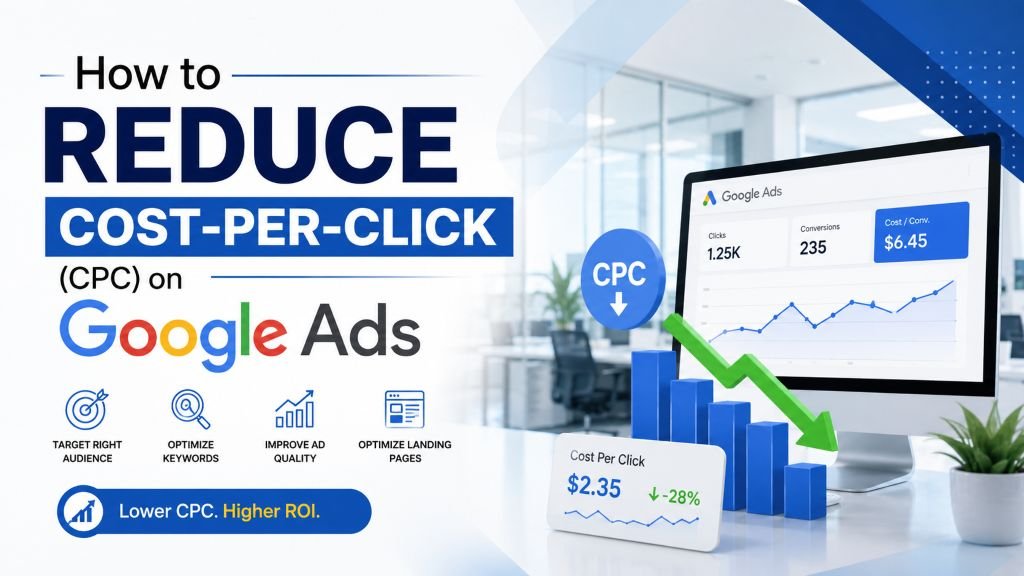
Quick answer: The most effective ways to reduce CPC on Google Ads are improving your Quality Score (through better ad relevance, ad extensions, and landing page experience), refining keyword match types to avoid paying for irrelevant clicks, adjusting bidding strategy, and narrowing geographic, device, or audience targeting to reduce competition for your specific ad placements. A Quality Score of 8–10 can cut CPC by roughly 25–50% compared to a low-scoring account bidding the same amount — making it the single highest-leverage lever available. Performance Max campaigns work slightly differently, since they don’t show a traditional keyword-level Quality Score (see below).
A high CPC isn’t necessarily a sign you’re targeting the wrong keywords — it’s often a sign that Google’s Quality Score system sees room for improvement in your ads, landing pages, or targeting precision. Here’s a systematic approach to bringing your costs down without sacrificing the traffic quality that actually converts.
Understand Quality Score First {#quality-score}
Google’s Quality Score (rated 1–10) reflects how relevant and useful Google considers your ad and landing page for a given keyword. It’s calculated from three components: expected click-through rate, ad relevance, and landing page experience. A higher Quality Score directly reduces the CPC needed to achieve the same ad position — meaning two advertisers bidding the same amount can pay meaningfully different actual costs based on this score alone. Google’s own Quality Score documentation explains how these three components are calculated in more detail.
8 Ways to Reduce CPC {#tactics}
1. Improve Ad Relevance to Your Keywords
If your ad copy doesn’t closely match the specific keywords in an ad group, Google judges it as less relevant, which raises effective CPC.
Fix: Use tightly themed ad groups — group closely related keywords together, and write ad copy that directly reflects those specific terms, rather than one broad ad covering many loosely related keywords.
2. Add Ad Extensions (Assets) to Every Campaign
This is one of the easiest wins available, and it’s often skipped. Ad extensions — sitelinks, callouts, structured snippets, and call extensions — increase your ad’s visible size and give searchers more reasons to click, which directly lifts expected CTR, one of the three Quality Score components.
Fix: Add sitelinks pointing to specific pages (pricing, services, contact), callouts highlighting differentiators, and call extensions if phone leads matter to your business. Review and refresh these periodically, same as ad copy.
3. Improve Landing Page Experience
A slow, irrelevant, or poorly designed landing page lowers your Quality Score even if your ad copy itself is strong.
Fix: Ensure your landing page loads quickly, clearly matches the ad’s promise, and provides a straightforward path to conversion (one clear call-to-action, not several competing options). If you’re running ecommerce campaigns specifically, our Ecommerce CRO Checklist covers the landing page and checkout factors that affect both conversion rate and, indirectly, Quality Score.
4. Refine Keyword Match Types
Overly broad targeting often pulls in clicks Google considers less relevant to your specific offer, which can quietly drag down performance metrics that feed into Quality Score.
Fix: Shift toward more precise match types (phrase or exact) for your core, highest-intent keywords, while using broad match more cautiously and only with strong negative keyword lists in place.
5. Build and Maintain Negative Keyword Lists
Every irrelevant click that doesn’t convert subtly drags down your account’s overall performance signals, in addition to wasting direct spend.
Fix: Review your Search Terms report weekly in the early stages of a campaign, adding clearly irrelevant terms as negative keywords on an ongoing basis.
6. Test and Refine Ad Copy Regularly
Stale ad copy that hasn’t been updated in months may no longer reflect the strongest-performing message for your current audience and competition.
Fix: Run multiple ad copy variations within each ad group and let Google’s testing identify top performers, then refine further based on results rather than “set and forget.”
7. Adjust Bidding Strategy Based on Campaign Maturity
Manual CPC bidding gives more direct control but requires active management; automated strategies like Target CPA or Maximize Conversions can optimize more efficiently once they have enough conversion data to learn from.
Fix: Start with more controlled manual or Maximize Clicks bidding while gathering data, then transition to automated bidding strategies once you have sufficient conversion volume (generally at least 15–30 conversions per month) for the algorithm to optimize effectively. One thing worth checking before you make this switch: automated bidding is only as good as the conversion data feeding it. If your tracking is undercounting conversions — increasingly common as browsers restrict third-party cookies — Target CPA and Maximize Conversions will optimize against incomplete data and can quietly push CPC in the wrong direction. Our guide on server-side tracking for Google Ads and GA4 covers how to fix this before switching bidding strategies.
8. Narrow Targeting to Reduce Unnecessary Competition
Bidding on broad, highly competitive geographic areas, devices, or audience segments you don’t genuinely need increases competition for the same ad placements, raising CPC unnecessarily.
Fix: Restrict targeting to your actual service area and genuinely relevant audience segments. Also check device-level performance — if mobile converts meaningfully better or worse than desktop for your business, adjust bids by device rather than treating all traffic the same.
Bonus: Schedule Ads During Higher-Converting Hours
If certain hours or days consistently show poor conversion rates relative to spend, continuing to bid at full strength during those windows wastes budget that could be redirected to better-performing times.
Fix: Use ad scheduling (dayparting) to reduce bids or pause ads during historically low-converting hours, based on your own account’s performance data.
Diagnose Before You Optimize: Use the Auction Insights Report
Before making changes, it’s worth understanding why your CPC is high in the first place. Google Ads’ built-in Auction Insights report shows how often you’re competing against the same advertisers, your impression share relative to them, and how often they outrank you — this tells you whether high CPC is a Quality Score problem, a genuine competitive/demand problem, or both, before you start changing settings.
Quality Score Works Differently in Performance Max {#pmax}
If you’re running Performance Max campaigns, the advice above still applies in principle, but you won’t see it the same way in your interface. Performance Max doesn’t display a traditional keyword-level Quality Score, because it doesn’t use keyword-level targeting at all. Instead, Google evaluates your asset group rating — shown as Low, Good, or Best — based on creative quality, asset diversity, and relevance to your audience signals and final landing page.
In practice, this means the same underlying principles still drive your costs:
- Upload a genuinely diverse range of headlines, descriptions, images, and videos per asset group rather than the bare minimum
- Keep your final URL and landing page tightly relevant to what each asset group promotes
- Feed PMax high-quality audience signals (your own customer lists, website visitors) rather than leaving it to find your audience from scratch
- Watch your asset group ratings the way you’d watch keyword Quality Scores in Search campaigns, and address any rated “Low” first
What NOT to Do to Reduce CPC {#avoid}
- Don’t simply lower bids without addressing the underlying Quality Score factors — this often just drops your ad position and visibility without solving the actual cost issue.
- Don’t switch to broad match thinking it will reduce costs — broad match can sometimes increase costs by pulling in more competitive, less targeted auctions.
- Don’t make several major changes simultaneously — this makes it impossible to identify which specific change actually affected your CPC.
Final Thoughts
Reducing CPC sustainably comes down to improving relevance and targeting precision — not just lowering bids and accepting reduced visibility. Quality Score improvements (and, for Performance Max, asset group rating improvements) compound over time, often allowing advertisers to pay less per click than competitors bidding the same amount but with weaker ad relevance and landing page experience.
Want a professional audit of your current campaigns?
ZestRank offers Google Ads management services in Delhi, including Quality Score optimization and ongoing campaign refinement to bring costs down sustainably. If broken conversion tracking is muddying your bidding data, we also handle server-side tracking fixes as part of a full account audit. Book a free PPC strategy session and we’ll review exactly what’s driving your current CPC.
Frequently Asked Questions {#faqs}
Does a higher Quality Score guarantee a lower CPC?
Generally yes — Google’s ad auction system rewards higher Quality Scores with lower costs needed to achieve the same ad position compared to lower-scoring competitors bidding similarly, though exact savings vary by competition level in your specific auction.
How long does it take to see CPC improvements after making changes?
Quality Score and CPC adjustments typically take 1–2 weeks of data accumulation to stabilize after small changes, and 30–90 days for larger Quality Score jumps, since Google needs sufficient new performance data to reassess relevance signals.
Can changing my bidding strategy alone reduce CPC?
It can help, particularly when transitioning to automated strategies with sufficient conversion data, but bidding strategy changes work best alongside the relevance and targeting improvements covered above, rather than as a standalone fix — and only if your conversion tracking is accurate to begin with.
Is a lower CPC always better for my business?
Not necessarily — the most important metric is usually cost-per-conversion, not CPC alone. A lower CPC that brings in less relevant traffic with poor conversion rates can actually be worse for your business than a slightly higher CPC that consistently converts well.
Does Quality Score apply to Performance Max campaigns?
Not in the traditional, visible sense. PMax doesn’t show a keyword-level Quality Score since it doesn’t use keyword targeting — instead, Google shows an asset group rating (Low, Good, Best) based on creative quality, diversity, and relevance, which reflects the same underlying quality principles.
About the Author: Rohit Nandan
Founder & Lead Digital Marketing ConsultantRohit Nandan is ZestRank's Founder & Lead Digital Marketing Consultant and YouTube SEO Expert, with over 15 years of experience diagnosing and running search campaigns for businesses across Delhi NCR. He personally reviews ZestRank's client projects, with deep expertise in technical SEO infrastructure and YouTube optimization. Have a question about this post? Message Rohit directly on WhatsApp.
Free Consultation
Ready to see how these exact parameters can be configured to expand your physical business discovery indices?
Request Strategy Call WhatsApp Strategist