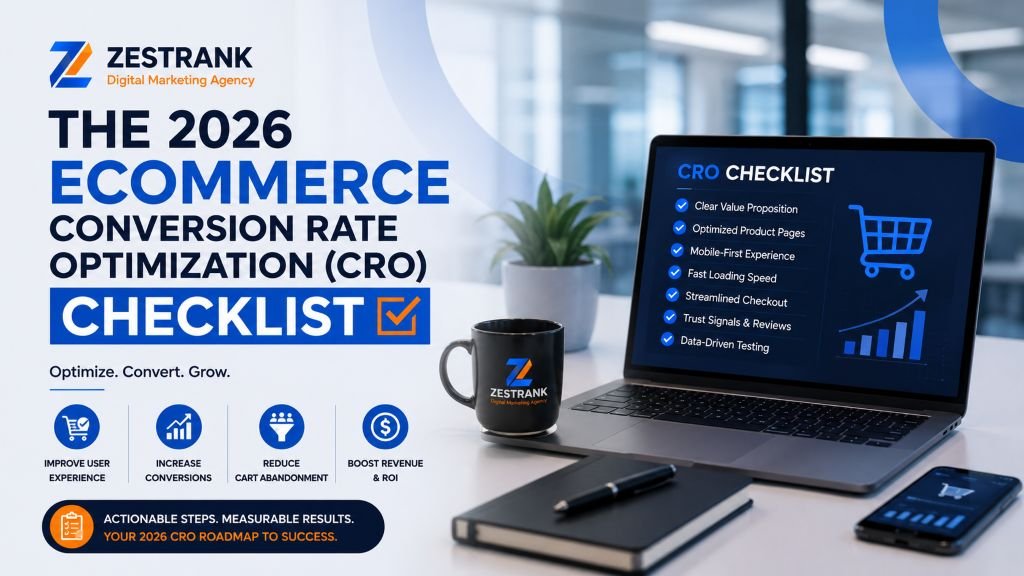
The 2026 Ecommerce Conversion Rate Optimization (CRO) Checklist
Rohit Nandan
Founder & Lead Digital Marketing Consultant
Quick answer: Ecommerce Conversion Rate Optimization (CRO) is the systematic process of increasing the percentage of website visitors who complete a purchase — by removing friction, building trust, and improving the match between what visitors expect and what they experience. The global average ecommerce conversion rate sits between 1–3%. Stores achieving 4–6%+ use most of the checklist items below. In 2026, there’s also a newer consideration worth watching: AI shopping agents like ChatGPT and Perplexity are increasingly completing purchases inside their own chat interfaces, which makes your product feed and structured data part of your conversion funnel now too, not just your website.
Traffic without conversion is just an expensive visibility exercise. If your ecommerce store is generating sessions but struggling to turn those sessions into sales, the problem is almost never the traffic source — it’s a friction point somewhere in the path between arrival and checkout completion. This checklist covers every CRO lever that actually moves the needle, organized in the order that typically delivers the fastest ROI.
What Is Ecommerce Conversion Rate Optimization?
Ecommerce CRO is the process of increasing the percentage of website visitors who make a purchase (or complete another desired action) without necessarily increasing traffic. A store converting at 1% of sessions and receiving 10,000 monthly visitors makes 100 sales. The same store converting at 3% makes 300 sales — triple the revenue from identical traffic spend.
Even a 0.5% improvement in conversion rate, compounded across your existing traffic, typically outperforms significant increases in ad spend at the same conversion rate. If your traffic itself needs work too, see our guide to reducing CPC on Google Ads or Google Ads vs Facebook Ads for where to source it efficiently.
Section 1: Homepage and First Impression
- Value proposition is clear above the fold — a visitor should know exactly what you sell, who it’s for, and why they should choose you within 5 seconds of arriving
- Primary CTA (Shop Now, Browse Collection, etc.) is visible without scrolling on both desktop and mobile
- Page load time is under 3 seconds — test with Google PageSpeed Insights; every second of additional load time reduces conversion rate by approximately 7%
- Trust indicators are visible on the homepage: secure payment badges, return policy summary, review count, years in business
- Navigation categories match how your customers think about your products — not how your internal team categorizes inventory
- Search bar is prominent and functional — visitors who use site search convert at 3–5x the rate of those who don’t
- No intrusive pop-ups appear within the first 5 seconds of arrival — immediate pop-ups increase bounce rate, not conversions
Section 2: Product Pages (Highest CRO Impact)
Product pages are where most ecommerce conversions are won or lost. This section deserves the most attention.
- Primary product image is high-resolution, zoomable, and shows the product on a real person or in real context — not just on a white background
- Multiple images showing different angles, in-use scenarios, size reference, and detail shots are present
- Product video is included for higher-value or complex products — product videos increase add-to-cart rates significantly
- Price is clearly visible without scrolling on mobile — never hide the price below a fold on a product page
- “Add to Cart” or “Buy Now” button is prominent, above the fold, and uses a high-contrast color distinct from the rest of the page
- Out-of-stock items show “Notify Me” option rather than a dead end — losing a visitor permanently is more costly than capturing them for a future sale
- Product description addresses the real reasons customers hesitate — not just features, but the specific objections and concerns your target customer has
- Reviews are present on the product page, not hidden on a separate tab — specifically seek reviews that mention the customer’s specific use case or concern
- Review count is shown alongside the star rating — 4.5 stars from 2 reviews is less convincing than 4.3 stars from 847 reviews
- Shipping estimate is visible on the product page — delivery uncertainty is one of the most common reasons for cart abandonment
- Return and refund policy is easy to find from the product page — “30-day free returns” prominently placed consistently lifts conversion
- Product variant selection (size, color, etc.) is intuitive — if a size is out of stock, show it as greyed out rather than removing it entirely
- Related products or “Frequently Bought Together” section is present and relevant — not just random product recommendations
- Product schema markup (Product, Offer, AggregateRating) is correctly implemented — beyond helping search results, this is now also the same structured data AI shopping surfaces read to represent your product accurately, covered further below
Section 3: Cart and Checkout (Where Revenue Leaks)
The average ecommerce cart abandonment rate is approximately 70%. Most of that abandonment is preventable.
- Cart is accessible via a persistent icon that shows item count — visitors should never wonder if something was successfully added
- Cart page shows product image, name, size/variant, quantity, and price for each item — reducing second-guessing
- Checkout is available as a guest option without mandatory account creation — forced account creation is one of the leading causes of checkout abandonment
- Checkout process is 3 steps or fewer — every additional step reduces completion rate
- Progress indicator shows where the customer is in the checkout process
- Payment options include UPI, credit/debit card, net banking, EMI, and buy-now-pay-later for Indian customers — limited payment methods directly reduce conversions
- Trust badges (SSL secured, payment logos) are visible on the checkout page itself — not just the homepage
- No unexpected charges appear at checkout — shipping costs or taxes appearing only at final checkout are the single largest driver of cart abandonment globally
- Checkout form only asks for genuinely necessary information — every additional field reduces completion rate
- Error messages are specific and helpful — “Invalid phone number” is better than a generic red error
- Customers can edit their order from the checkout page without losing their entered information
- Your conversion tracking is actually capturing these completions accurately — a large share of “abandoned” carts reported by ad platforms are really a tracking gap, not real abandonment; see our guide to server-side tracking and fixing GA4/ads data if your numbers look inconsistent
Recover Abandoned Carts on WhatsApp
This is a distinctly high-impact lever for Indian ecommerce specifically that most CRO checklists (written for a US audience) never mention. WhatsApp Business’s Catalog and automated messaging features let you send a direct, personal abandoned-cart reminder — often with a one-tap link back to checkout — to a channel Indian shoppers already check constantly, typically outperforming abandoned-cart email for open and response rates. See our guide to WhatsApp Business marketing for small businesses in India for how to set this up properly.
Section 4: Mobile Experience
In India, over 70% of ecommerce traffic comes from mobile devices. If your mobile experience isn’t excellent, your CRO ceiling is very low regardless of how good your desktop experience is.
- All touch targets (buttons, links) are large enough to tap without mis-hitting — minimum 44×44 pixels
- Text is readable without zooming on any product page or checkout screen
- Images load quickly on mobile connections — compress all product images
- Mobile checkout does not require pinching, zooming, or horizontal scrolling at any point
- Autofill works correctly for address and payment fields on mobile
- The primary “Add to Cart” button is visible without scrolling on the most common mobile screen sizes
- Filter and sort functionality works cleanly on mobile — difficult filtering causes visitors to give up on finding what they want
Section 5: Trust and Social Proof
Trust is the most underrated conversion variable in ecommerce, particularly for brands that aren’t yet household names.
- Real customer reviews with names, photos, and dates are present and plentiful
- Video testimonials or user-generated content exists for your top-selling products
- Any press mentions, certifications, or awards are displayed prominently
- Physical address and phone number are visible on the site — these dramatically increase trust for first-time buyers uncertain about your legitimacy
- Social media links work and show an active, real account — a dead social profile damages trust more than having no link
- Return and refund policy is written in plain language without fine print that feels adversarial
- “As seen in” or media logos are present if you have any press coverage
- Founder story or “About Us” page humanizes the brand — especially important for D2C brands
Section 6: Speed and Technical Performance
- Core Web Vitals pass in Google Search Console — Largest Contentful Paint under 2.5 seconds, Cumulative Layout Shift under 0.1
- Images use modern formats (WebP) and are correctly sized for display dimensions
- Third-party scripts (chat widgets, analytics, tracking pixels) are loaded asynchronously so they don’t block page rendering
- Server response time is consistently under 200ms — consider a CDN if you have international customers
- Avoid the technical SEO mistakes that hurt both rankings and page load times simultaneously — several of them, like JavaScript rendering issues, directly affect whether product content is even visible to crawlers, AI or otherwise
Explore ZestRank’s free SEO and marketing tools to check your product pages are properly optimized for both search visibility and page performance — better click-through and faster pages both translate into more qualified, higher-converting traffic reaching your store.
Section 7: Post-Purchase and Retention
CRO doesn’t end at the purchase. Second purchases convert at dramatically higher rates than first purchases — optimizing for repeat buying multiplies lifetime value.
- Order confirmation page and email are clear, reassuring, and include tracking information as soon as it’s available
- Post-purchase email sequence includes delivery confirmation, a check-in for satisfaction, and a timely review request
- Repeat purchase incentive (discount on next order, loyalty points) is offered at the right moment — typically with or just after the first order confirmation
- Returns and exchanges process is frictionless — a good returns experience is the single biggest driver of repeat purchasing in ecommerce
Section 8: Get Ready for AI Shopping Agents (Emerging, Not Yet Core)
This is genuinely new for 2026 and worth understanding, even if it isn’t yet where most Indian ecommerce revenue comes from. AI platforms — ChatGPT, Perplexity, and Google’s newer AI Mode shopping features — are increasingly letting people research, compare, and in some cases complete purchases without leaving the chat interface, drawing on the same product-feed data (structured data, Google Merchant Center feeds, GTIN completeness) that powers traditional Shopping ads.
For most small and mid-sized Indian ecommerce stores, this isn’t an urgent overhaul — traditional website conversion still drives the overwhelming majority of revenue today. But the preparation work overlaps almost entirely with good CRO and SEO fundamentals you should be doing anyway:
- Keep product schema markup (covered in Section 2) accurate and complete — this is the same data AI shopping surfaces read.
- If you use Shopify, check whether your plan includes any AI storefront syndication features as they roll out, since this requires no extra product data work once enabled.
- Treat this as a “watch and prepare” item rather than a “drop everything” item — revisit it every few months as adoption in the Indian market becomes clearer.
How to Prioritize This Checklist
Don’t try to fix everything simultaneously. Use this sequence:
First week: Fix anything in Section 3 (Cart and Checkout), including setting up WhatsApp abandoned cart recovery if you haven’t already. This section has the highest concentration of conversion-blocking issues and the fastest measurable impact on revenue.
Second week: Audit your top 5 product pages against Section 2. Your best-traffic pages with the most improvement potential come first.
Third and fourth week: Address Section 4 (Mobile) and Section 1 (Homepage). These affect all visitors equally and have broad impact.
Ongoing: Section 5 (Trust), Section 6 (Technical), and Section 8 (AI shopping readiness) build over time with accumulated reviews, speed improvements, and content development.
Final Thoughts
A single percentage point improvement in conversion rate on a store doing ₹50 lakhs per month in revenue equals ₹50,000 in additional monthly sales — from the same traffic. For a store doing ₹5 crore, it’s ₹5 lakhs per month. CRO investment pays compounding returns on every future rupee of traffic you generate.
Want a professional CRO audit of your store?
ZestRank offers SEO and digital marketing services that include ecommerce technical audits covering speed, structure, and on-page conversion factors, alongside PPC management if your traffic itself needs work. If a common reason your ads “aren’t converting” turns out to be tracking rather than the store itself, our guide on why PPC campaigns don’t convert is worth a read too. Not sure who to trust with an audit? See what to ask before hiring a marketing agency in Delhi. Book a free audit session and we’ll identify your highest-impact CRO opportunities this week.
Frequently Asked Questions
What is a good ecommerce conversion rate in India?
The average ecommerce conversion rate globally sits between 1–3%. Indian ecommerce stores tend to see conversion rates slightly below global averages due to high mobile traffic share and price sensitivity, but top-performing Indian stores in competitive categories regularly achieve 3–5% by executing the fundamentals in this checklist well.
How long does CRO take to show results?
Unlike SEO, which takes months to build rankings, CRO improvements can show measurable results within days or weeks — especially fixes in the checkout flow or product page trust elements, which have immediate impact on sessions already arriving at the store.
Do I need special software for CRO?
A/B testing tools (VWO, Optimizely, and similar platforms, since Google Optimize was discontinued) are useful for testing changes before committing them, but many of the highest-impact CRO improvements — like adding reviews, clarifying shipping policy, or simplifying checkout — don’t require testing tools at all. Fix the obvious friction points first, then use testing tools for more nuanced optimizations.
Is CRO different for mobile vs. desktop?
The principles are the same but the execution differs. Mobile CRO focuses heavily on touch target size, above-fold visibility of key elements, and form completion ease. Desktop CRO often has more room for detailed product information and comparison tools. Given India’s mobile-first user base, mobile CRO typically delivers higher absolute impact.
What is the relationship between SEO and CRO?
SEO brings more relevant traffic to your store. CRO converts more of that traffic into sales. They compound: better SEO means more visitors, better CRO means a higher percentage of those visitors buy. Investing in one without the other leaves significant revenue on the table.
Should Indian ecommerce stores worry about AI shopping agents like ChatGPT or Perplexity right now?
Not urgently — most Indian ecommerce revenue still comes through traditional website visits, and this is an emerging channel primarily rolling out through US-based integrations first. It’s worth keeping product schema and feed data accurate, since that work benefits traditional search and CRO regardless, but it doesn’t need to displace the fundamentals in this checklist.
Have a question about this post? Message Rohit directly on WhatsApp or book a free strategy call. For more breakdowns like this, browse the ZestRank blog, or learn more about our team.
About the Author: Rohit Nandan
Founder & Lead Digital Marketing ConsultantRohit Nandan is ZestRank's Founder & Lead Digital Marketing Consultant and YouTube SEO Expert, with over 15 years of experience diagnosing and running search campaigns for businesses across Delhi NCR. He personally reviews ZestRank's client projects, with deep expertise in technical SEO infrastructure and YouTube optimization. Have a question about this post? Message Rohit directly on WhatsApp.
Free Consultation
Ready to see how these exact parameters can be configured to expand your physical business discovery indices?
Request Strategy Call WhatsApp Strategist