Google Ads vs Facebook Ads: Where Should You Spend Your Budget in 2026?
Rohit Nandan
Founder & Lead Digital Marketing Consultant
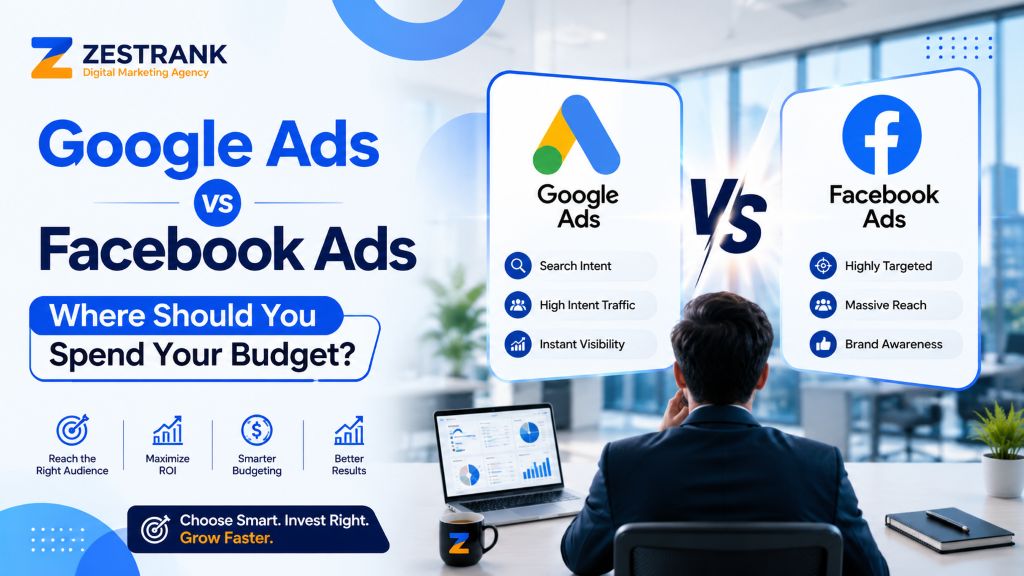
Quick answer: Google Ads is generally better for capturing existing demand — reaching people actively searching for what you offer — while Facebook and Instagram (Meta) Ads are better for creating demand among people who fit your ideal customer profile but aren’t actively searching yet. In India, Meta Ads clicks are typically far cheaper (roughly ₹2–₹35) than Google Search clicks (roughly ₹24–₹60), but Google’s clicks usually convert at a higher rate because the intent is already there. Most small businesses get the best results running both — the right starting split depends on your sales cycle and how many people already know they need what you sell.
If you have a limited budget and have to choose between Google Ads and Meta Ads, the decision isn’t about which platform is “better” — it’s about which one matches how your specific customers actually buy, and increasingly, how much you’re willing to hand over to each platform’s AI.
How Google Ads Works
Google Ads shows your ad to people actively searching for relevant keywords on Google. It captures existing intent — someone has already decided they need a plumber, a CRM tool, or a pair of running shoes, and your ad appears right when they’re looking. Through 2026, Google has pushed most Search advertisers toward AI Max and Performance Max, which use Gemini to match your landing pages and assets to a much broader set of user intent signals than a fixed keyword list ever could — meaning “keyword targeting” is now closer to a starting signal than the whole strategy.
Best suited for:
- Businesses with clear, searchable demand (services, products people actively look for)
- Local businesses targeting “near me” or location-based searches
- High-intent purchases where people research before buying
How Facebook (Meta) Ads Works
Facebook and Instagram (Meta) Ads show your ad to people based on demographics, interests, and behavior — not because they searched for anything, but because they match a profile likely to be interested. It creates demand and awareness rather than capturing existing intent. Meta has moved through a similar automation shift: Advantage+ is now the default campaign type across most objectives, using Meta’s Andromeda ranking system to handle audience, placement, and increasingly creative decisions from a single business input.
Best suited for:
- Visually appealing products that perform well in feed-based discovery (fashion, food, home decor)
- Building brand awareness for a new product or business
- Retargeting people who’ve already visited your website or engaged with your content
- WhatsApp click-to-message ads, which run through the same Meta ecosystem and work especially well for WhatsApp-driven lead generation in India
Direct Comparison
| Factor | Google Ads | Facebook / Meta Ads |
|---|---|---|
| Intent level | High — user is actively searching | Lower — user is browsing, not searching |
| Best for | Direct response, immediate need | Awareness, consideration, visual products |
| Targeting basis | Keywords/search intent, increasingly AI-expanded | Demographics, interests, behavior, AI-driven lookalikes |
| Typical India CPC | ₹24–₹60 average (₹5–₹600+ range) | ₹2–₹35 typical (₹0.50–₹60 range by industry) |
| Typical India CPL | Varies widely by industry, often ₹150–₹2,500 | Often ₹100–₹2,000 depending on industry |
| AI automation | AI Max / Performance Max | Advantage+ |
| Time to results | Can be faster for high-intent purchases | Often needs more touches before conversion |
What Google Ads and Meta Ads Actually Cost in India (2026)
This is the number most comparisons skip, and it changes the decision more than any “which is better” framing.
Google Ads: Average CPC on Search sits around ₹24–₹60, with a real range from about ₹5 at the cheap end to ₹600+ for high-value categories like legal, insurance, and B2B SaaS. If your current CPC feels too high, see our guide on how to reduce CPC on Google Ads before assuming the channel isn’t working for you.
Meta Ads: Facebook and Instagram clicks in India are typically much cheaper — often ₹2–₹35, with some low-competition niches as low as ₹0.50–₹8 and competitive categories like real estate or finance running ₹12–₹60. CPM (cost per 1,000 impressions) generally runs ₹50–₹400.
The catch: cheaper clicks don’t automatically mean cheaper leads. Meta’s lower intent means a meaningful share of clicks won’t convert, so cost-per-lead across both platforms often lands in a similar ₹100–₹2,500 range depending on industry — the real comparison to make is cost-per-lead and cost-per-customer, not cost-per-click.
When Google Ads Usually Wins
- Your customers actively search for your service (“emergency plumber,” “best dentist near me,” “buy laptop online India”)
- You’re a local service business relying on immediate, high-intent local searches
- Your sales cycle is short and decision-driven once someone starts looking
- New to paid search? Start with our Google Ads for beginners guide.
When Facebook Ads Usually Wins
- Your product is visually compelling and benefits from feed-based discovery
- You’re launching something new that people don’t yet know to search for
- You want to retarget past website visitors or engage an existing audience (past customers, page followers)
- Your budget needs to stretch further for broader reach and awareness-building — and your organic Instagram content is already building an audience worth retargeting, as covered in our Instagram algorithm 2026 breakdown
The 2026 Shift: Both Platforms Now Run on AI
The bigger change this year isn’t Google vs. Meta — it’s that both platforms have quietly moved advertiser control from manual targeting toward AI-managed delivery. Google’s AI Max for Search and Performance Max now expand beyond your exact keyword list using Gemini to match intent signals, while Meta’s Advantage+ handles audience, placement, and bid decisions by default across most new campaigns. In practice, this means:
- Your job has shifted from picking keywords or audiences to feeding the algorithm good signals — clear conversion tracking, distinct creative variations, and a defined KPI matter more than manual tuning now.
- Attribution has gotten murkier on both platforms, since AI-managed campaigns can take credit for conversions that would have happened anyway. Running periodic holdout tests (pausing a campaign for a segment to see if conversions actually drop) is the most reliable way to check real incrementality.
- Clean measurement matters more than ever precisely because the platforms are automating more — our guide to server-side tracking to fix GA4/ads data is worth reading before you lean further into either platform’s automation.
Which Channel Fits Your Type of Business
Local service business (salon, clinic, repair, home services): Google Search usually wins first — “near me” searches are high-intent and Google’s local click costs are often reasonable for this category.
E-commerce: Both matter, but for different jobs. Meta (via Advantage+) is strong for discovery and visual-first product marketing; Google Shopping and Search catch people already comparing options. See our e-commerce conversion rate optimization checklist to make sure the traffic from either platform actually converts once it lands.
B2B or high-ticket services: Google Search captures people actively researching solutions; Meta can work well for awareness and retargeting decision-makers who aren’t searching yet, though CPLs tend to run higher here on both platforms.
New brand with zero existing audience: Lean Meta first — Google Ads depends on people already searching for your brand or solution, which a brand-new business hasn’t earned yet.
Why Many Businesses Use Both
Google Ads and Meta Ads often work better together than alone. A common, effective pattern:
- Use Facebook/Instagram Ads to build awareness and drive initial website traffic or engagement.
- Use Google Ads (Search) to capture people who are now actively searching for your brand or solution, including those previously exposed to your Meta ads.
- Use Meta retargeting to bring back website visitors who didn’t convert on their first visit.
This layered approach uses each platform for what it does best, rather than expecting one channel to do everything. It’s the same underlying logic as the SEO vs PPC decision — sequence channels by what they’re good at, don’t force one to do a job it wasn’t built for.
Common Mistakes Small Businesses Make
- Comparing platforms on CPC alone. A cheap Meta click that doesn’t convert is more expensive than a pricier Google click that does — always compare cost-per-lead.
- Splitting a small budget too thin across both. Fragmenting a limited budget across Google and Meta can starve both of the data they need to optimize; for very small budgets, it’s often better to prove out one platform first. This is also a common reason a PPC campaign isn’t converting despite reasonable spend.
- Handing everything to Advantage+ or Performance Max without clean tracking. AI-managed campaigns are only as good as the conversion signals you feed them.
- Sending Meta traffic to a generic homepage instead of a dedicated landing page built for a cold, low-intent visitor.
- Never running an incrementality check to see whether AI-automated campaigns are creating new demand or just claiming credit for organic conversions.
How to Decide If You Can Only Choose One
Ask yourself:
- Do people actively search for what I offer? If yes, lean Google Ads.
- Is my product something people discover rather than search for? If yes, lean Facebook/Instagram Ads.
- What’s my budget? Smaller budgets often stretch further on Meta due to generally lower cost-per-click, though conversion rates can be lower too — factor in cost-per-acquisition, not just cost-per-click.
- How long is my typical sales cycle? Long, considered purchases often benefit from Meta’s ability to nurture awareness over time before a Google Ads search converts them.
Final Thoughts
There’s no universally “better” platform — only the one that matches how your specific customers move from awareness to decision, and increasingly, how well you feed each platform’s AI. Many small businesses in Delhi NCR find the strongest results from a deliberate mix of both, rather than betting the entire budget on one channel.
Not sure which mix is right for your business?
ZestRank offers dedicated PPC services and social media marketing — part of our broader digital marketing services — to help you allocate budget across the right channels based on real data, not guesswork. Not sure who to trust with the spend? Read what to ask before hiring a marketing agency in Delhi first. Book a free PPC strategy session and we’ll map out where your budget should actually go.
Frequently Asked Questions
Is Google Ads more expensive than Facebook Ads in India?
Cost-per-click is usually higher on Google Ads (₹24–₹60 average vs. ₹2–₹35 for Meta), but Google Ads also tends to capture higher-intent users, which can result in a similar or lower overall cost-per-acquisition despite the higher click cost. Compare cost-per-lead, not cost-per-click, before deciding.
Which platform is better for a brand-new business with no existing audience?
Facebook/Instagram Ads often work well for building initial awareness and audience for a new business, since Google Ads relies on people already searching for your brand or solution, which a brand-new business may not yet have.
Can I run Google Ads and Facebook Ads with a small budget?
Yes, though splitting a very small budget across both platforms can limit the data each one’s AI needs to optimize effectively. For very limited budgets, it’s often better to start with one platform, gather sufficient data, and expand once you understand what’s working.
Do Google Ads and Facebook Ads use the same targeting method?
No, though they’ve converged somewhat. Google Ads primarily targets based on search keywords and intent (now AI-expanded via AI Max/Performance Max), while Meta Ads targets based on demographic, interest, and behavioral data via Advantage+, along with custom and retargeting audiences.
Do Performance Max and Advantage+ mean I don’t need to manage my campaigns anymore?
No — they shift what you manage. Instead of hand-picking keywords or audiences, your job becomes feeding the AI clean conversion data, distinct creative variations, and a clear KPI, and periodically checking incrementality to confirm the AI is creating new demand rather than just claiming credit for conversions that would have happened anyway.
Have a question about this post? Message Rohit directly on WhatsApp or book a free strategy call. For more breakdowns like this, browse the ZestRank blog, or learn more about our team.
About the Author: Rohit Nandan
Founder & Lead Digital Marketing ConsultantRohit Nandan is ZestRank's Founder & Lead Digital Marketing Consultant and YouTube SEO Expert, with over 15 years of experience diagnosing and running search campaigns for businesses across Delhi NCR. He personally reviews ZestRank's client projects, with deep expertise in technical SEO infrastructure and YouTube optimization. Have a question about this post? Message Rohit directly on WhatsApp.
Free Consultation
Ready to see how these exact parameters can be configured to expand your physical business discovery indices?
Request Strategy Call WhatsApp Strategist