Local SEO for Restaurants in Delhi: Complete 2026 Guide
Rohit Nandan
Founder & Lead Digital Marketing Consultant
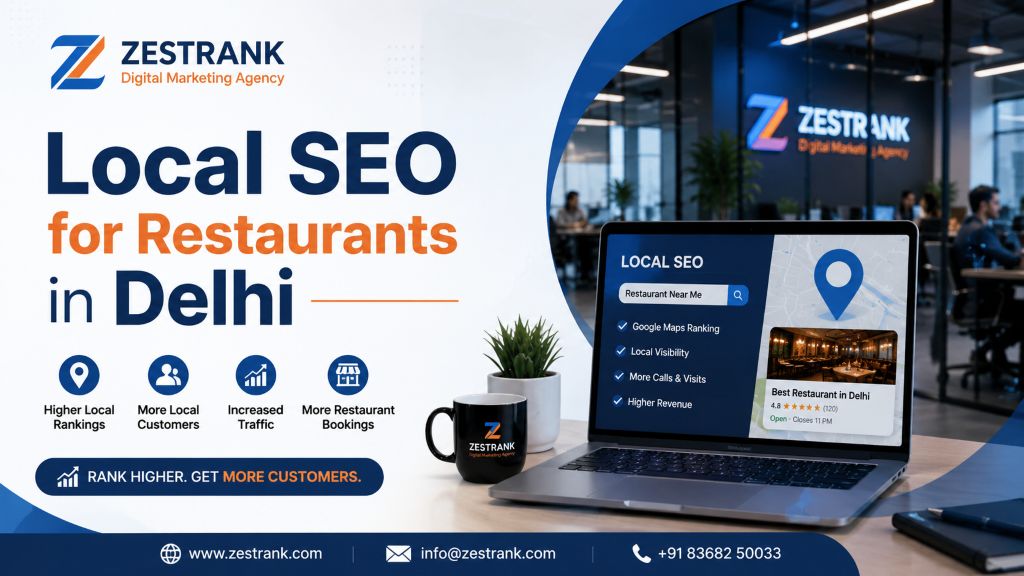
Quick answer: Local SEO for restaurants in Delhi means optimizing your Google Business Profile with accurate cuisine categories, a complete (and machine-readable) menu, and consistent recent reviews — while keeping your listings aligned across Zomato, Swiggy, and Google. In 2026, it also means making sure your menu and reviews are structured so Google’s AI Overviews and voice assistants can actually recommend you, not just so a human can read your listing.
Few searches are as immediate and high-intent as “restaurants near me” or “best biryani in Lajpat Nagar” — someone is hungry, nearby, and ready to decide within minutes. For restaurants and cafes in Delhi NCR, ranking well in these searches isn’t a long-term branding play; it’s a direct driver of walk-ins and orders, often within the hour. Here’s how to actually win that visibility in 2026.
Why Restaurant Local SEO Is Different {#why-different}
Unlike many local businesses, restaurants compete on an intensely visual, immediate-decision basis. Diners often decide within seconds based on photos, ratings, and how recently a listing has been updated — making Google Business Profile activity and image quality more directly tied to conversions than in most other local categories.
Google ranks every local listing on three core pillars — relevance, distance, and prominence — a framework Google explains in its own Business Profile help documentation. What’s changed in 2026 is how Google measures relevance: its AI systems now read the actual text of your reviews to understand vibe and occasion, not just your star rating. A review that says “perfect for a date night, quiet corner tables” can help you surface for that exact search — something a 4.5-star average alone never could.
Step 1: Optimize Your Google Business Profile for Food Search {#steps}
For the full field-by-field setup, including current video verification requirements, see our Google Business Profile Optimization Guide — the notes below cover what’s specific to restaurants.
- Choose the most accurate primary category — “Indian Restaurant,” “Cafe,” “North Indian Restaurant” — rather than a generic “Restaurant” category.
- Add secondary categories for additional relevant attributes (e.g., “Vegetarian Restaurant,” “Delivery Restaurant” if applicable).
- Fill in the Menu section completely with item names, descriptions, and prices — one of the most-used features by diners deciding whether to visit.
- Set accurate hours, including separate lunch/dinner or delivery-only windows. Inaccurate hours are now one of the fastest ways to lose Map Pack visibility — Google increasingly checks whether a business is genuinely open at the moment someone searches, not just whether hours are listed.
- Add attributes diners filter by: outdoor seating, takeout, delivery, dine-in, family-friendly, alcohol served, parking available.
- Turn on Order Online and Reservations links directly on your Google profile if you offer them — this keeps diners one tap from converting without ever leaving Google, and it’s free visibility most restaurants skip.
Step 2: Make Photos a Priority, Not an Afterthought
Food-related searches are among the most visually driven in all of local search — visual browsing now plays a major role in how diners shortlist restaurants before they ever read a review.
- Upload high-quality photos of your actual dishes, not stock images — diners can usually tell the difference, and Google’s algorithm rewards fresh, original images.
- Add interior and ambiance photos so visitors know what to expect before walking in.
- Upload new photos regularly — a genuinely active profile signals relevance and trustworthiness far more than a static one that hasn’t changed in months.
Step 3: Build a Menu Google’s AI Can Actually Read
This is the step most Delhi restaurant websites get wrong, and it’s become far more important in 2026.
- Use an HTML menu on your website, not a PDF. Search engines and AI systems struggle to extract dish names, prices, and descriptions from PDF menus — effectively making your menu invisible to the systems increasingly recommending restaurants in AI Overviews and chat-based search.
- Add Menu and Restaurant schema markup to your website. This structured data tells Google explicitly what you serve, at what price, and under what category — it’s how you start ranking for dish-level searches like “best butter chicken near Saket,” not just your restaurant’s name. If you’re not sure what this looks like, schema.org’s Menu documentation is the technical reference; in practice, this is usually a developer or agency task rather than a manual edit.
- Keep the website itself fast and mobile-friendly — most “near me” searches happen on a phone, and a slow-loading menu page loses diners before it even finishes rendering.
Step 4: Build Consistency Across Food-Specific Platforms
Beyond Google, Delhi diners heavily reference:
- Zomato and Swiggy — for both ordering and browsing reviews/menus before deciding
- Dineout and EazyDiner for reservations and offers
- Justdial and magicpin — still widely used for local discovery in Delhi NCR, especially outside the immediate premium market
- Instagram — increasingly the first place diners check for a restaurant’s actual vibe, recent dishes, and events, especially for cafes and younger-audience venues
Make sure your restaurant name, address, phone number, and menu pricing are consistent across all of these and your Google Business Profile. Inconsistency between platforms — different prices, different hours — creates confusion and directly erodes the “prominence” and trust signals Google uses to rank you.
Step 5: Generate Reviews the Right Way — and Respond to Every One
Reviews carry outsized weight for restaurants, and in 2026 they do double duty: they build trust with diners and feed Google’s AI matching for specific search intents.
- Ask satisfied diners for a Google review as they’re paying or leaving, when satisfaction is highest.
- Train staff to mention it naturally rather than relying solely on table signage, which is often ignored.
- Encourage specific, descriptive reviews where possible — mentions of a dish, the occasion, or the atmosphere help you surface for those exact searches later.
- Respond to every review, especially negative ones, ideally within a couple of days — a calm, specific response to a complaint (not generic, not defensive) often reassures future diners more than the negative review itself deters them.
- Never buy or incentivize fake reviews. Google’s fake-review detection has gotten significantly more aggressive, and a policy sweep can wipe out a large batch of reviews — and your Map Pack ranking with them — almost overnight. Steady, authentic review growth beats a review-count shortcut every time.
Step 6: Create Location and Cuisine-Specific Website Content
If you have a website, don’t rely on a single generic homepage to carry your SEO weight.
- Write content around specific dishes or cuisine specialties you’re known for (“Best Butter Chicken in Saket” rather than just a generic menu page).
- Mention your specific neighborhood and nearby landmarks naturally — this reinforces hyper-local relevance for “near me” searches.
- If you have multiple locations, give each one its own dedicated page rather than combining them.
- Add a hyper-local FAQ section answering the fuller, conversational questions diners now ask voice assistants and AI search — parking availability, dietary options (vegan, gluten-free, Jain food), and vibe (“good for a business lunch,” “quiet for conversation”). This kind of structured Q&A content is exactly what AI Overviews pull from when answering multi-part questions.
Step 7: Use Google Posts for Daily Specials and Events
- Post specials, limited-time menu items, or events (live music, festive menus) using Google Business Profile Posts — aim for at least a couple of posts a week. Posting frequency has become one of the stronger signals of an “active,” trustworthy profile in Google’s current local ranking model.
- Include a clear call-to-action (“Order Now,” “Book a Table,” “Call Now”) on each post.
Quick Reference Checklist {#checklist}
| Step | Action | Why it matters |
|---|---|---|
| 1 | Optimize GBP: category, menu, hours, Order Online/Reservations | Core relevance and conversion signal |
| 2 | Upload real, fresh photos regularly | Diners decide visually, in seconds |
| 3 | Build an HTML menu with schema markup, not a PDF | Makes dishes discoverable to AI search |
| 4 | Keep Zomato, Swiggy, Justdial, Instagram consistent | Prevents trust-eroding mismatches |
| 5 | Generate specific, recent reviews and respond to all | Feeds both trust and AI vibe-matching |
| 6 | Write dish/cuisine-specific content + hyper-local FAQ | Wins “near me” and AI Overview queries |
| 7 | Post weekly on GBP with a clear CTA | Signals an active, trustworthy profile |
For the ranking-factor mechanics behind all of this — citations, review velocity, and how Google actually weighs these signals — see our Google Maps ranking guide.
Common Mistakes Restaurants Make With Local SEO {#mistakes}
- Generic or incorrect primary category, hurting relevance for specific cuisine searches
- Inconsistent pricing or hours across Google, Zomato, and Swiggy
- Stale photos that no longer represent the current menu or interior
- Menus published only as PDFs, making them unreadable to search engines and AI assistants
- Ignoring negative reviews instead of responding calmly and specifically
- Chasing review count through incentivized or fake reviews, risking a policy suspension
- No mention of specific dishes or specialties anywhere in online content, relying only on the restaurant name to carry all the SEO weight
Final Thoughts
Restaurant local SEO in Delhi rewards visual freshness, review authenticity, and platform-wide accuracy more than almost any technical SEO trick — but in 2026, the technical basics (a crawlable HTML menu, proper schema markup) decide whether you’re even eligible to be recommended by Google’s AI in the first place. Diners decide fast, and every inconsistency — a wrong price, a stale photo, an unanswered bad review, a menu Google can’t read — costs you a walk-in that was otherwise ready to choose you.
For a broader look at ranking across other local categories in the region, see our guide to Local SEO Tips for Delhi NCR Businesses, and for a real example of what consistent local SEO work looks like over time, read our case study on scaling a local business’s leads by 410%.
Want this set up properly for your restaurant or cafe?
ZestRank offers specialized local SEO services in Delhi for restaurants and food businesses — from Google Business Profile optimization and menu schema setup to review generation systems. This same hyper-local approach extends across other Delhi NCR neighborhoods and cuisines as your business grows. Get a free local SEO audit for your restaurant today.
Frequently Asked Questions {#faqs}
Does having a website matter for restaurant local SEO, or is Google Business Profile enough?
Google Business Profile alone can drive significant visibility in Maps and “near me” searches, but a website with cuisine and location-specific content — plus proper menu schema — gives you ranking signals and AI-search eligibility that GBP doesn’t fully cover on its own.
How important are Zomato and Swiggy reviews compared to Google reviews?
Both matter for different reasons — Google reviews most directly affect your Maps and search visibility, while Zomato/Swiggy reviews influence ordering decisions directly within those apps, which many Delhi diners use as their primary discovery and ordering platform.
How often should a restaurant update its Google Business Profile?
Active, weekly engagement — new photos, a Google Post about a special or event, and prompt responses to new reviews — keeps the profile signaling as relevant, which supports both ranking and diner trust.
Can a new restaurant compete with established ones in local search?
Yes — Google Maps ranking depends on relevance, distance, and prominence, not how long a business has existed. A new restaurant with a complete, well-optimized profile and a steady stream of authentic reviews can outrank an established competitor with a neglected, outdated listing.
Do AI Overviews affect how restaurants get discovered now?
Yes. A significant and growing share of local searches now surface an AI-generated answer before the traditional list of results, and that answer draws on structured menu data, review text, and profile completeness. A restaurant with a crawlable HTML menu, schema markup, and detailed reviews is far more likely to be recommended by name than one relying on a PDF menu and a bare star rating.
Is it worth adding schema markup if I’m not technical?
Yes, but it’s typically a one-time developer task rather than something you maintain manually — worth doing once properly (or having an agency set up) since it directly affects whether your dishes are discoverable in dish-level and AI-powered searches going forward.
About the Author: Rohit Nandan
Founder & Lead Digital Marketing ConsultantRohit Nandan is ZestRank's Founder & Lead Digital Marketing Consultant and YouTube SEO Expert, with over 15 years of experience diagnosing and running search campaigns for businesses across Delhi NCR. He personally reviews ZestRank's client projects, with deep expertise in technical SEO infrastructure and YouTube optimization. Have a question about this post? Message Rohit directly on WhatsApp.
Free Consultation
Ready to see how these exact parameters can be configured to expand your physical business discovery indices?
Request Strategy Call WhatsApp Strategist