Top Digital Marketing Trends in India for 2026
Rohit Nandan
Founder & Lead Digital Marketing Consultant
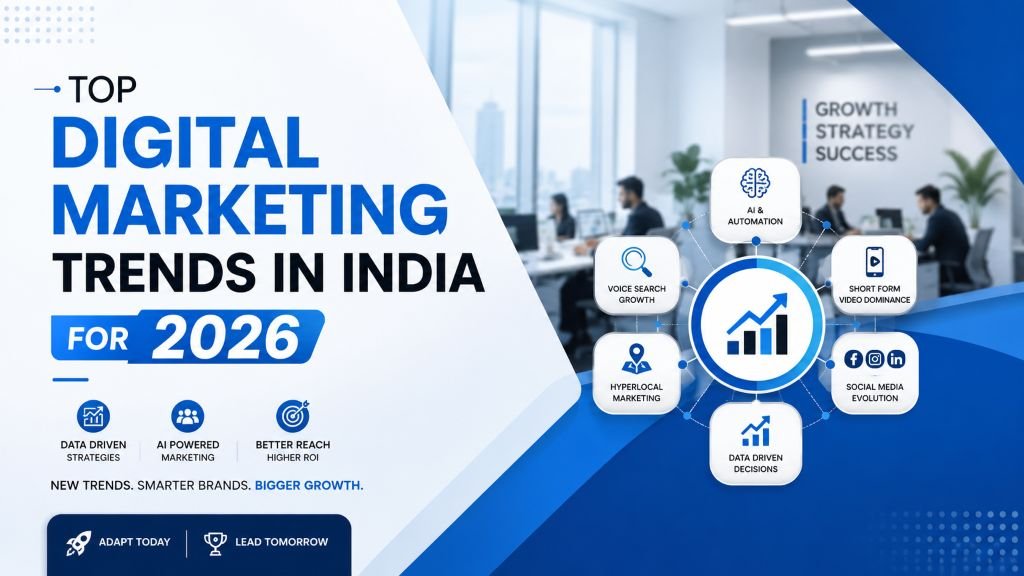
Quick answer: The biggest digital marketing trends shaping India in 2026 are the rise of AI-powered search (Google AI Overviews and chatbot-driven discovery), continued dominance of short-form video, the explosive growth of regional-language content, quick commerce platforms like Blinkit and Zepto becoming major ad channels, growing investment in local and hyper-regional targeting, and increased emphasis on first-party data as third-party tracking continues to decline. Small businesses benefit most from prioritizing AI-search-friendly content, at least basic regional-language presence, and consistent local SEO over chasing every emerging trend.
Digital marketing in India is evolving faster than most businesses can track, but not every trend deserves equal attention. India’s digital ad market itself reflects this pace — industry estimates put it at roughly $14–15 billion in 2026, growing at a double-digit rate toward an estimated $20 billion-plus by 2029. Here’s what’s genuinely shaping strategy for Indian businesses in 2026, and which trends are worth prioritizing for a small or mid-sized business specifically.
The 9 Trends Shaping 2026 {#trends}
1. AI-Powered Search Is Changing How People Find Businesses
Google’s AI Overviews and AI-driven chat tools (like ChatGPT, Perplexity, and Google’s own Gemini-powered search features) are increasingly answering queries directly, sometimes without the user clicking through to a website at all. ZestRank now offers dedicated AI Search Optimization as a standalone service.
What this means for businesses: Content needs to be structured clearly enough for AI systems to extract and cite — direct answers near the top of a page, clear definitions, and well-organized FAQs all help content get surfaced by these systems, not just traditional organic listings. For a deeper look at this shift specifically, see Generative Engine Optimization (GEO) Explained and SEO Didn’t Die in 2026.
2. Short-Form Video Continues to Dominate Attention
Reels, YouTube Shorts, and similar short-form formats remain the primary way many Indian consumers discover new businesses and products, particularly younger demographics.
What this means for businesses: Even service-based businesses that historically relied on static content are increasingly finding video — quick tips, behind-the-scenes, customer testimonials — essential for organic reach on Instagram and YouTube.
3. Regional and Vernacular-Language Content Is a Major Growth Driver
This is arguably the most distinctly Indian trend on this list, and one of the largest. Roughly 73% of India’s internet users now consume content in regional languages — Hindi, Tamil, Telugu, Bengali, Marathi, Kannada, and others — a share that industry analysts expect to keep climbing as internet adoption deepens in Tier-2 and Tier-3 cities. Platforms built around vernacular content, like ShareChat and Dailyhunt, are seeing rising advertiser interest specifically because of this shift.
What this means for businesses: A digital strategy built entirely in English is increasingly leaving a large, growing share of the addressable Indian market unaddressed, especially outside metro cores. This doesn’t require full-scale operations in every language — even a Hindi-language landing page, ad set, or set of Reels for your highest-value regional market can capture demand that English-only competitors are missing. Genuine cultural localization (not literal translation) performs meaningfully better than word-for-word conversion.
4. Quick Commerce Platforms Are Becoming Major Advertising Channels
Blinkit, Zepto, and Swiggy Instamart have moved well beyond fast grocery delivery — they’ve built genuine digital advertising infrastructure that now competes directly with Google and Meta for ad budgets, particularly from consumer goods and D2C brands.
What this means for businesses: For brands selling physical products with quick-commerce availability, this is a newer, increasingly important channel to evaluate, especially since it closes the loop between ad exposure and purchase faster than almost any other format — a customer can see an ad and have the product delivered within minutes. Service businesses without a quick-commerce presence can generally treat this as lower priority, but ecommerce and CPG brands should be tracking it closely.
5. Hyper-Local and Regional Targeting Is Growing
As digital ad costs rise in broad, competitive categories, more businesses are investing specifically in local SEO and geographically narrow targeting rather than competing nationally.
What this means for businesses: A well-optimized Google Business Profile and locally-focused content increasingly outperform broader, less targeted campaigns on a cost-per-lead basis, especially for service businesses tied to a physical location.
6. First-Party Data Is Becoming More Valuable
With ongoing changes to third-party cookie tracking and increased privacy regulation, businesses that build their own email lists, WhatsApp subscriber bases, and direct customer relationships have a growing advantage over those relying solely on platform-provided targeting.
What this means for businesses: Lead magnets, email capture, and WhatsApp-based customer communication are becoming more strategically important, not just nice-to-have additions.
7. WhatsApp Business Continues to Expand as a Marketing Channel
WhatsApp’s dominance in Indian digital communication has extended firmly into marketing — order updates, customer service, product catalogs, and even direct promotional messaging through WhatsApp Business API integrations. For D2C brands with mature WhatsApp automation, the channel now reportedly contributes a meaningful double-digit share of total digital revenue in some cases.
What this means for businesses: Businesses that build WhatsApp into their customer journey (order confirmations, review requests, support, and increasingly full catalog-to-checkout flows) often see better engagement than relying on email alone, given how central WhatsApp already is to daily communication in India. We cover this in full depth in WhatsApp Business Marketing for Small Business in India.
8. Performance Marketing Is Becoming More Data-Disciplined
As ad costs across platforms rise, businesses are shifting from “spend and hope” toward stricter, conversion-tracked performance marketing — every rupee tied to a measurable outcome rather than vanity metrics like impressions or likes.
What this means for businesses: Proper conversion tracking, clear attribution, and disciplined budget allocation across channels matter more than ever, especially for smaller businesses where every rupee of ad spend needs to be justified.
9. Voice and Conversational Search Are Slowly Growing
While still a smaller share of overall search behavior in India compared to text search, voice queries through smartphones and smart assistants are gradually increasing, particularly for local, conversational queries (“best biryani place open now near me”) — and increasingly in Hindi and regional languages, not just English.
What this means for businesses: Content written in a natural, conversational tone — directly answering specific questions — tends to perform better for this type of search behavior than keyword-stuffed, robotic phrasing.
What Should a Small Business Actually Prioritize in 2026? {#priorities}
With limited time and budget, not every trend deserves equal investment.
| Priority | Why it’s high-leverage |
|---|---|
| Local SEO & Google Business Profile | Directly drives nearby customer discovery, lowest cost-per-lead for local businesses |
| Short-form video content | Strongest organic reach driver, doesn’t require high production value |
| AI-search-structured content | Clear answers and FAQs help you get surfaced by AI Overviews and chat tools, not just rankings |
| Basic first-party data capture | Even a simple email or WhatsApp opt-in builds a durable asset independent of any platform’s algorithm |
| At least one regional-language touchpoint | Captures demand from the fastest-growing, most underserved segment of India’s internet users |
Final Thoughts
2026’s digital marketing landscape in India rewards businesses that combine fundamentals — strong local SEO, genuine video content, disciplined performance tracking — with awareness of how AI is reshaping search discovery and how much of India’s growth is happening outside English-language, metro-only audiences, rather than chasing every new platform feature or trend individually.
Want a 2026-ready marketing strategy for your business?
ZestRank is a digital marketing agency in Delhi helping businesses prioritize the trends that actually move revenue — from local SEO to social media to PPC. Book a free strategy call and we’ll help you build a focused plan for the year ahead.
Frequently Asked Questions {#faqs}
Is AI search going to replace traditional SEO in India?
Not entirely — traditional organic search remains significant, but AI-powered search features are increasingly part of the discovery process. The most resilient strategy optimizes for both, since well-structured, genuinely useful content tends to perform well across both traditional rankings and AI-driven answer extraction.
Do small businesses in India really need video content in 2026?
For most categories, yes — video, particularly short-form, remains one of the strongest organic reach drivers on Instagram and YouTube. It doesn’t need to be highly produced; consistency and genuine usefulness matter more than production value.
Is performance marketing only relevant for large businesses?
No — performance marketing principles (clear tracking, measurable goals, disciplined budget allocation) apply at any budget size. Smaller businesses arguably benefit more from this discipline, since every rupee of limited ad spend needs to be justified by results.
Should every business invest in WhatsApp marketing?
Most businesses serving Indian consumers benefit from at least basic WhatsApp integration (order updates, review requests, customer support), given how central the platform is to daily communication, though the depth of investment should match your specific customer base and communication needs.
Does a small business really need regional-language content, or is English enough?
It depends on your audience, but with roughly 73% of India’s internet users now consuming content in regional languages, English-only content increasingly misses a large and growing share of the market — especially outside metro cores. Even one well-localized regional-language touchpoint can capture demand that English-only competitors leave on the table.
Is quick commerce advertising relevant for service businesses, or just product brands?
Mainly product brands and ecommerce/CPG businesses that can actually be discovered and delivered through Blinkit, Zepto, or Swiggy Instamart. Service businesses (agencies, clinics, real estate, local services) generally get more value from local SEO and Google Business Profile investment instead.
About the Author: Rohit Nandan
Founder & Lead Digital Marketing ConsultantRohit Nandan is ZestRank's Founder & Lead Digital Marketing Consultant and YouTube SEO Expert, with over 15 years of experience diagnosing and running search campaigns for businesses across Delhi NCR. He personally reviews ZestRank's client projects, with deep expertise in technical SEO infrastructure and YouTube optimization. Have a question about this post? Message Rohit directly on WhatsApp.
Free Consultation
Ready to see how these exact parameters can be configured to expand your physical business discovery indices?
Request Strategy Call WhatsApp Strategist