Programmatic SEO in 2026: Generate 1,000+ High-Ranking Pages Safely

Rohit Nandan
Founder & Lead Digital Marketing Consultant
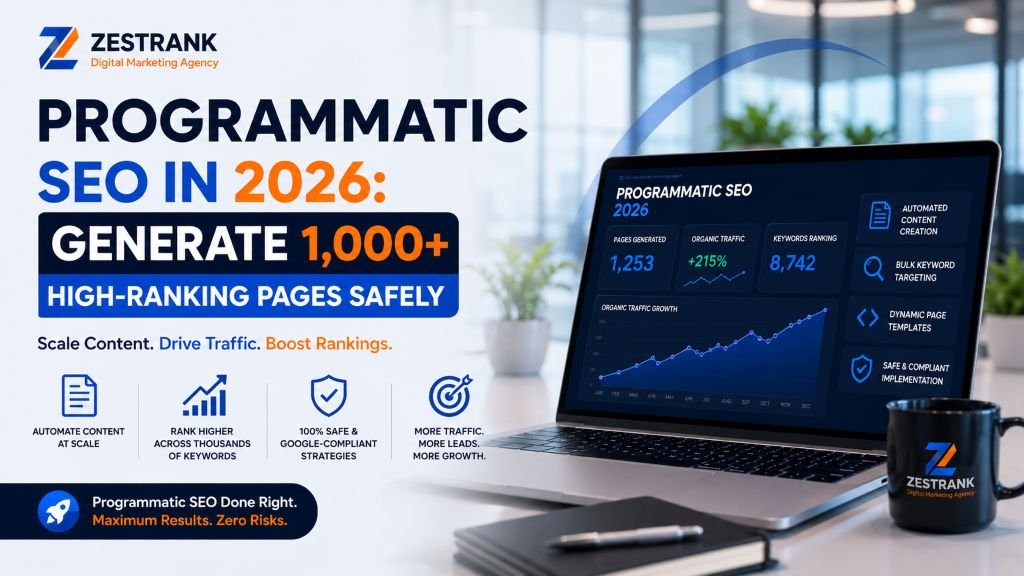
Quick answer: Programmatic SEO (pSEO) is the practice of automatically generating hundreds or thousands of SEO-optimized web pages at scale by combining a consistent page template with a structured data set — so each page targets a unique keyword combination. Done correctly, it allows a single team to own entire keyword categories that would take years to build manually. Done incorrectly, it now triggers Google’s scaled content abuse policy directly — Google’s March 2026 core update specifically named this as an enforcement priority, and sites with thin, template-swapped pages saw ranking losses of 50–90% almost overnight.
Some of the fastest-growing websites in the world — Zapier, Canva, Tripadvisor, NoBroker, Justdial — get a significant share of their traffic from programmatic SEO. They don’t have editorial teams writing thousands of individual articles. They have structured data, smart templates, and a systematic approach that lets them own entire keyword universes at a scale no manual content process can match.
This is programmatic SEO. And in 2026, the line between what Google rewards and what it penalizes has become very specific — and very enforced. This guide shows you exactly which side of that line to stay on.
What Is Programmatic SEO?
Programmatic SEO is the creation of large volumes of web pages at scale using a template combined with a structured data source. Instead of writing each page individually, you build one high-quality template and populate it with different data for each page — typically targeting variations of a core keyword pattern.
Classic examples:
- Zapier: “Connect [App A] with [App B]” — thousands of integration pages, each targeting a unique app combination query
- Tripadvisor: “Best hotels in [City]” — millions of location-specific pages
- Canva: “[Type] templates” — thousands of design category pages
- Justdial: “[Service] in [Location]” — covering every service-location combination in India
- Wise: over 1.7 million programmatic pages across 20 markets driving roughly 90% of its organic traffic — one of the clearest examples of pSEO done at genuine scale with real data behind every page
Each individual page targets a low-to-medium volume keyword that would be economically impractical to target with manually written content. But at scale, the aggregate traffic from thousands of these pages becomes enormous.
How Programmatic SEO Works — The Core Components
Component 1: The Keyword Matrix
Every pSEO strategy starts with identifying a scalable keyword pattern — a combination of two or more variables that creates unique, searchable queries at scale.
The formula: [Modifier A] + [Modifier B] = unique page
Examples:
- [Service] + [City/Neighbourhood] → “CA services in Lajpat Nagar”
- [Product type] + [Use case] → “running shoes for flat feet”
- [Comparison] → “Salesforce vs HubSpot”
- [Job title] + [Tool] → “Excel templates for accountants”
The modifier combinations must represent real searches — not invented permutations nobody actually searches for.
Component 2: The Data Source
Your programmatic pages are only as good as the data populating them. The data source is typically:
- A database or spreadsheet with structured information (cities, categories, specifications, prices)
- An API feeding real-time data (property listings, job openings, product inventory)
- A CMS with structured custom fields for each entry
Component 3: The Page Template
The template defines what every programmatic page looks like — headings, content sections, image placements, FAQs, internal links, schema markup. The template is the same across all pages; only the data variables change.
Component 4: Unique Value on Every Page
This is where 2026 pSEO diverges sharply from the approaches that are now being penalized. Every page must offer something genuinely useful and unique — not just swapped variables in a thin template.
What Google’s March 2026 Update Actually Did to Programmatic SEO
This is the section every 2026 pSEO guide needs and most don’t have: specifics, not just a general warning. Google’s March 2026 core update explicitly named scaled content abuse as a primary enforcement target, and its Search Relations team was unusually direct about the three violation patterns it targeted:
- Mass AI page generation without editorial review — sites publishing 50–500 AI-written pages per day across keyword clusters, with no human review and no first-hand information behind the content.
- Pure template-with-variable substitution — the classic “Best [service] in [city]” pattern where only the city name changes and nothing else offers local insight or genuine value.
- Aggregator pages with no added context — content stitched or scraped from other sources with nothing original layered on top.
Sites matching these patterns saw ranking losses of 50–90%, with the enforcement mechanism being algorithmic (visible in ranking drops, not a Search Console manual action message) and the full impact landing within about two weeks of the update’s rollout. Practitioners tracking recovery cases note that once roughly 30% or more of a site’s indexed URLs get flagged as low-value internally by Google’s systems, a sitewide demotion tends to follow — and recovery from that typically takes 6–12 months even after the underlying pages are fixed or removed. This makes Step 4 and Step 5 below (indexing selectively and pruning regularly) far more than housekeeping — they’re now a direct defense against a real, demonstrated penalty risk.
One more strategic reality worth knowing before you invest heavily in pSEO: the long-tail queries pSEO is built to capture are increasingly being answered directly by AI Overviews, which cuts into exactly the traffic pSEO pages depend on — click-through on AI-Overview-triggering keywords has dropped sharply even for #1 rankings. This doesn’t make pSEO a bad strategy, but it means the ROI calculation has shifted: genuinely useful, data-rich pages that get cited by AI Overviews and other AI search tools now matter as much as pages that just rank. Our pieces on why keyword-only SEO is failing in AI search and Generative Engine Optimization (GEO) cover this shift in more depth.
The Safe Programmatic SEO Framework for 2026
Step 1: Choose a Keyword Pattern With Genuine Data Behind It
Only build programmatic pages where you have real, unique data to populate each page. “Best plumbers in [city]” only works if you have actual plumber data — ratings, phone numbers, services, addresses — that’s different and useful for each city page.
Step 2: Ensure Each Page Has Genuine Unique Content
Beyond the data variables, each page should have:
- At least one section of genuinely location/context-specific content
- Unique user-generated data (reviews, ratings, prices) where possible
- FAQs relevant to the specific variation (not identical FAQs across all pages)
- A practical benchmark some practitioners use post-March 2026: aim for at least 60% of a page’s content to be genuinely distinct from any other page in the cluster, drawing from more than one data source where possible — a much higher bar than the “swap one variable” approach that used to pass.
- If AI tools are used to draft the unique content sections, put a human review layer in the workflow before publishing — this is specifically what separates compliant, AI-assisted pSEO from the “mass AI generation without editorial review” pattern that drove the March 2026 penalties.
Step 3: Build Strong Internal Linking Across the Cluster
Programmatic pages work best when they’re organized into navigable clusters — category hub pages linking to individual variation pages, and individual pages linking to related variations and back to hubs. This mirrors how Justdial and similar sites structure their directory hierarchies, and it also helps with the crawl-budget and index-bloat issues covered in our technical SEO mistakes guide.
Step 4: Index Selectively — Not Everything Deserves to Be Indexed
If your data set has 10,000 entries but only 2,000 of them target queries with meaningful search volume, index only those 2,000. The rest should either be noindexed or not generated at all. Thin, low-value programmatic pages that get indexed drag down your site’s overall quality signal — and given the ~30% flagged-URL threshold referenced above, this step is now closer to risk management than optimization.
Step 5: Monitor and Prune Regularly
Programmatic SEO requires ongoing maintenance. Pages that have been indexed for 6+ months with zero impressions in Search Console are candidates for either improving or deindexing. Keeping a high average quality across your indexed page set protects your overall domain trust. If you’re seeing high impressions but unexpectedly low clicks across your programmatic cluster, that’s often an AI Overview or ghost-impression pattern rather than a ranking problem — see our guide on ghost impression keywords for how to diagnose it.
Practical Programmatic SEO Applications for Indian Businesses
Local service directories — If you offer SEO, marketing, or any professional service across multiple cities, programmatic pages targeting “[service] in [city]” are a natural fit. Our guide on local SEO for real estate in Noida and Gurugram shows the niche-specific content depth that makes individual location pages genuinely useful rather than thin, and our broader local SEO tips for Delhi NCR businesses covers the fundamentals underneath it.
Product/specification pages — If you sell products with multiple attribute combinations (size, color, material, use case), programmatic product category pages can own long-tail variations systematically.
Comparison pages — “[Product A] vs [Product B]” at scale, with genuinely structured comparison data for each pair — this is exactly the pattern that works well for B2B SaaS SEO strategy, where competitor comparison searches are high-intent and genuinely underserved by thin content.
Educational tool pages — ZestSmartTools itself uses this model — each tool page targets a specific “free [tool name] online” query. Explore ZestRank’s free SEO and marketing tools to see the pattern in practice and research which tool-specific keyword variations have genuine search demand before building pages for them.
Building Your First Programmatic SEO System — Step by Step
Step 1 — Validate the keyword pattern. Before building anything, confirm that the keyword pattern actually has search volume across its variations. Use keyword research tools to sample 20–30 specific combinations and verify they have real monthly search volume — even modest individual volume adds up at scale.
Step 2 — Audit your data quality. Review your data source for every field that will appear on the page. Incomplete data (missing phone numbers, empty descriptions, no images) creates low-quality pages that hurt the cluster. Fix or exclude incomplete data entries before generating pages.
Step 3 — Build and test the template on 10 pages. Before scaling to hundreds or thousands, build 10 representative pages using your template and submit them to Google for indexing. Monitor how Google crawls, renders, and eventually ranks these test pages before scaling.
Step 4 — Implement proper schema markup on the template. Whatever schema type fits your content (LocalBusiness, Product, Article, FAQPage) should be implemented once in the template and automatically populated with the right data variables for each page.
Step 5 — Set up a monitoring dashboard. Track impression growth, indexing rate, and ranking progress for your programmatic cluster in Search Console. Create a filtered view showing just the URL pattern of your programmatic pages so you can monitor the cluster’s performance as a unit — and watch for the early warning signs of a scaled-content-abuse risk before a core update finds them for you.
Common Programmatic SEO Mistakes That Trigger Penalties
- No unique content beyond the variable swap — city name changed, everything else identical across 500 pages; this is the single pattern Google’s March 2026 update targeted most directly
- Targeting zero-volume keyword combinations — creating pages for combinations nobody searches for just to have more pages
- No internal linking structure — programmatic pages floating in isolation with no hub pages linking to them
- Duplicate meta titles/descriptions — every page should have unique title and description populated from the data set, not a generic template with one variable
- Indexing every page regardless of quality — thin or data-incomplete pages should be noindexed
- No topical depth on the hub/category pages — hub pages that are themselves thin undermine the entire cluster’s authority
- No human editorial review of AI-assisted content — publishing AI-drafted page content straight through without review is now one of the clearest, named enforcement triggers
Final Thoughts
Programmatic SEO in 2026 rewards the same thing that Google has always ultimately rewarded: genuine usefulness at scale — and it now punishes the absence of it more decisively and more quickly than it used to, following the March 2026 enforcement wave. The sites that are winning with pSEO are those that built real databases of real information and structured it into pages that genuinely help specific people find specific things. The sites getting penalized are those that saw pSEO as a shortcut to mass content generation with no real value behind it.
The opportunity is still enormous — especially for local service businesses, directories, and tools platforms looking to systematically own keyword categories across India’s still-underserved regional and niche markets. It just now requires the same editorial discipline at page 1,000 that a careful team would apply at page 1.
Want to build a programmatic SEO strategy for your business?
ZestRank offers SEO services that include programmatic content architecture for businesses ready to scale their organic presence systematically. If you’re building this out for the first time, our Answer Engine Optimization (AEO) playbook and how long SEO actually takes to show results in India are worth reading alongside this guide. Not sure who to trust with a build this technical? See what to ask before hiring a marketing agency in Delhi. Book a strategy session and we’ll identify the right keyword patterns for your specific business and data.
Frequently Asked Questions
What is the difference between programmatic SEO and regular SEO?
Regular SEO involves manually researching, writing, and optimizing each individual page. Programmatic SEO creates large volumes of pages automatically using templates and structured data, allowing a single team to own thousands of keyword variations that would be impossible to address manually at scale.
How many pages do you need for programmatic SEO to work?
There’s no minimum, but the model typically makes most sense when you’re targeting 50+ keyword variations that share a consistent pattern. Below that, manual content production is usually more efficient. The real payoff of programmatic SEO comes at 200+ pages where the aggregate traffic from many individually modest-volume pages becomes significant.
Can programmatic SEO get my site penalized by Google?
Yes, and this is no longer theoretical — Google’s March 2026 core update specifically enforced its scaled content abuse policy against thin, repetitive pSEO content, with affected sites seeing ranking losses of 50–90%. Safe pSEO requires genuine unique data, human editorial review of any AI-assisted content, and useful content variation across pages, not just automated text generation.
Does programmatic SEO work for local businesses?
Yes — local service businesses are one of the best fits for programmatic SEO, specifically for “[service] in [location]” keyword patterns. The key is having genuinely location-specific content on each page, not just a city name inserted into an otherwise identical template.
How long does programmatic SEO take to show results?
Programmatic pages typically take 2–4 months to begin ranking meaningfully, similar to manually created content. However, because you’re deploying many pages simultaneously targeting different low-competition variations, you often see aggregate traffic growth faster than a single-page manual approach — more pages ranking for more terms at a faster collective rate.
Is programmatic SEO still worth it now that AI Overviews answer a lot of long-tail queries directly?
Yes, but the strategy needs to account for it. Pages that are genuinely data-rich and useful can still get cited within AI Overviews and other AI search results, which partly offsets the click-through decline on traditional rankings. Thin, template-only pages lose on both fronts — traditional ranking risk and no AI citation value — which is another reason the genuine-uniqueness bar matters more in 2026 than it used to.
Have a question about this post? Message Rohit directly on WhatsApp or book a free strategy call. For more breakdowns like this, browse the ZestRank blog, or learn more about our team.
About the Author: Rohit Nandan
Rohit Nandan is ZestRank's Founder & Lead Digital Marketing Consultant and YouTube SEO Expert, with over 15 years of experience diagnosing and running search campaigns for businesses across Delhi NCR. He personally reviews ZestRank's client projects, with deep expertise in technical SEO infrastructure and YouTube optimization. Have a question about this post? Message Rohit directly on WhatsApp.
Free Consultation
Ready to see how these exact parameters can be configured to expand your physical business discovery indices?
Request Strategy Call WhatsApp Strategist