Case Study: How We Scaled a Local Business’s Leads by 410% Using SEO
Rohit Nandan
Founder & Lead Digital Marketing Consultant
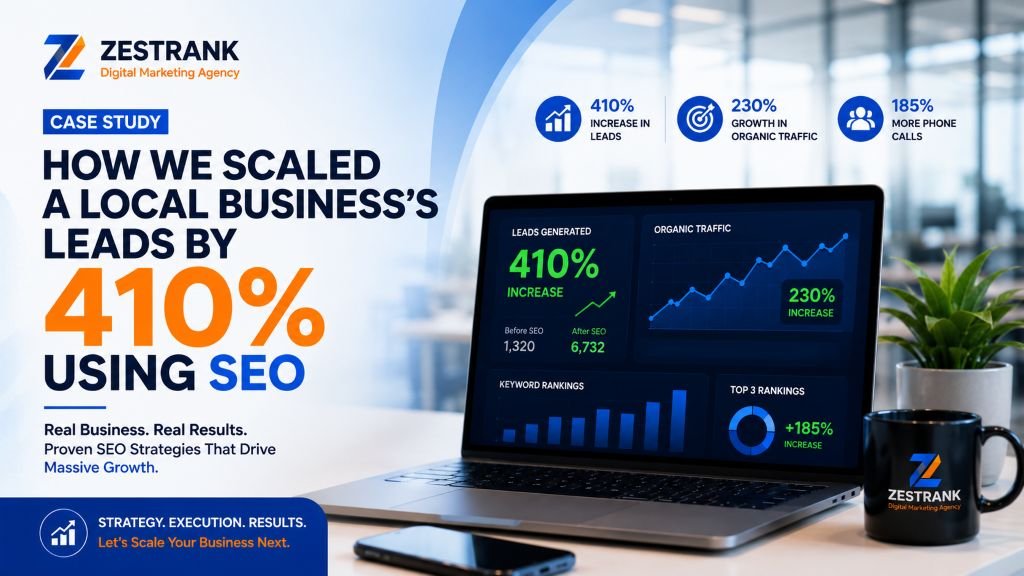
Quick answer: This case study covers a 9-month SEO engagement for a multi-location healthcare clinic group in Delhi NCR that grew from 47 qualified monthly leads from organic search to 240 — a 410% increase — through a combination of Google Business Profile optimization, technical SEO fixes, location-specific content pages, and a structured review generation system. No paid advertising was involved.
Numbers like “410% growth” can sound like marketing copy. So this case study is going to show you the specific steps, in the specific sequence we executed them, with the specific results at each stage — so you can evaluate whether the approach is real and whether it’s applicable to your own business.
The Client: A Multi-Location Healthcare Clinic Group in Delhi NCR
The client is a group of 4 specialist healthcare clinics operating across South Delhi and Noida — physiotherapy, orthopaedics, and sports medicine. Names and specific identifying details are kept confidential by agreement, but the numbers and strategy are shared in full.
Starting point (Month 0):
- 4 physical locations with a single shared website
- 47 organic leads per month (phone calls and form submissions from organic traffic)
- 3 Google Business Profiles — one location hadn’t claimed theirs
- Average Google Maps position: not in top 7 for primary keywords in any location
- Domain Authority: 14 (new-ish domain, limited backlinks)
- Zero location-specific content on the website
Goal: Increase qualified organic leads (patients calling or booking from organic search) without paid advertising.
Timeline: 9 months
Phase 1 (Months 1-2): Technical Foundation and GBP Setup
Before building anything, we audited what was broken. Here’s what the technical audit found:
Critical Issues Found
Issue 1: NAP Inconsistency Across All 4 Locations The clinic name appeared differently across Google, Justdial, and the website. One location was listed as “Delhi Physio & Sports Clinic” on Google and “Delhi Physiotherapy and Sports Medicine” on Justdial. Phone numbers had different formats (with/without country code, with/without spaces). This inconsistency was actively weakening the trust signals Google uses for Maps ranking.
Fix: Standardised the exact business name, address format, and phone number across every online mention — Google Business Profile, website footer, Justdial, Practo, Lybrate, and the 4 individual location pages we would build.
Issue 2: One Location Not Verified on Google The Noida location had an unverified Google Business Profile — it had been created but never completed the postcard/phone verification step. An unverified profile essentially doesn’t compete in Maps rankings.
Fix: Completed verification for all 4 locations within the first 2 weeks.
Issue 3: Generic Primary Category on All Profiles All 4 GBPs were set to the primary category “Medical Clinic” — the most generic possible option. No secondary categories were set at all.
Fix: Each location’s primary category was updated to the most specific accurate option:
- Physiotherapy practice → “Physical Therapist”
- Orthopaedic clinic → “Orthopedic Clinic”
- Sports medicine location → “Sports Medicine Physician”
Secondary categories were added for every relevant service type at each location.
Issue 4: Website Had No Individual Location Pages The website had a single “Contact Us” page with all 4 locations listed together. Google had no location-specific content to index and rank for geo-targeted queries like “physiotherapist in Vasant Kunj” or “sports injury clinic Noida Sector 50.”
Fix planned for Phase 2 — creating 4 dedicated location pages, one per clinic.
GBP Content Optimisation (Done in Month 1)
Beyond fixing the structural issues, each GBP was fully optimised:
- Business description rewritten to 750 characters, naturally including location names, specialties, and the types of conditions treated
- 45 photos uploaded across all 4 profiles in the first month (interior, team, equipment, facility)
- Services section completed for each location with specific treatments listed
- Hours verified and updated (the website and Google had different hours for one location)
- Booking/appointment link added to all profiles
Month 2 Results After GBP Fixes:
- All 4 locations appeared in Google Maps for their primary specialty category + area searches (previously none were showing consistently)
- Maps impressions increased from baseline by 180% in 6 weeks purely from GBP completeness improvements
Phase 2 (Months 2-4): Location Pages and Content
Building 4 Dedicated Location Pages
Each clinic location got its own dedicated website page with:
Unique content per page:
- Location-specific introduction referencing the neighbourhood, nearby landmarks, and transport links
- The specific treatments and specialists available at that location (different across locations)
- Embedded Google Map for that exact address
- Local phone number and address formatted consistently with GBP
- “Conditions we treat at [Location Name]” section — specific to that clinic’s specialties
- Team profiles for doctors/physiotherapists at that location
On-page SEO per location page:
- Title: “[Primary Specialty] in [Neighbourhood] | [Clinic Name]”
- H1: “[Primary Specialty] Clinic in [Neighbourhood Name], [City]”
- Natural mention of surrounding neighbourhoods and areas within 3-5km
- Schema markup: LocalBusiness + MedicalClinic + Physician for each page
Traffic impact: By Month 4, all 4 location pages were indexed and appearing in position 4–11 for their respective neighbourhood-specific queries — not yet in the top 3, but generating impressions and early clicks.
Specialty Content Cluster
Beyond location pages, we built a content cluster around the primary conditions each clinic treats — targeting “want to know” and “want to do” intent searches that typically precede appointment bookings:
Articles written:
- “How to recover from ACL injury without surgery — physiotherapy approach” (targets pre-surgery research)
- “Difference between a physiotherapist and orthopaedic surgeon — which do I see first?”
- “Sports injury treatment in Delhi: when to go to A&E vs a specialist clinic”
- “Knee pain treatment in Noida — what your options are”
- “How many physiotherapy sessions does [common condition] typically require?”
Each article was optimised for the informational query and included a clear CTA (“Book a consultation at our [nearest location] clinic”) with direct links to the relevant location page.
Phase 3 (Months 4-7): Review Generation and Citation Building
The Review System
At the start of the engagement, the review situation was:
- Location 1: 23 Google reviews, 4.2 stars
- Location 2: 11 Google reviews, 4.4 stars
- Location 3: 8 Google reviews, 3.9 stars
- Location 4: 0 Google reviews (unverified profile, previously unclaimed)
By Month 7:
- Location 1: 97 reviews, 4.7 stars
- Location 2: 64 reviews, 4.6 stars
- Location 3: 51 reviews, 4.4 stars
- Location 4: 38 reviews, 4.8 stars
The process that generated this:
- Review request card given to every patient at checkout, with a QR code linking directly to the Google review form for their location.
- WhatsApp follow-up message sent 48 hours after the appointment: “Hi [Name], we hope your appointment with [Doctor Name] was helpful. If you have 30 seconds, a Google review would mean a lot to us — [direct review link].”
- Reception staff trained to verbally mention the review request to patients who expressed satisfaction during their visit — “We’d really appreciate it if you could leave us a quick Google review.”
- All reviews responded to within 48 hours — including negative ones, with calm, specific, non-defensive responses.
Impact on Maps ranking: Review velocity (the rate of new reviews arriving) is a strong prominence signal. As all 4 locations built consistent weekly review influx, their Maps positions moved steadily upward — particularly Location 3, which went from being outside the top 10 to position 2 in its primary area search after its review count and quality improved significantly.
Citation Building
Over 3 months, we built consistent NAP citations across:
- Practo (most important for healthcare in India — completed and verified all 4 locations)
- Lybrate (second-tier but meaningful for healthcare discovery)
- Justdial (standardised after fixing the NAP inconsistencies from Phase 1)
- Sulekha
- Google Maps (already handled)
- IndiaMart (for the sports medicine location serving corporate clients)
- Local neighbourhood and RWA websites where clinic addresses were relevant
Total new citation sources: 22 platforms across all 4 locations.
Phase 4 (Months 7-9): Refinement and Scale
By Month 7, organic leads had grown from 47/month to 127/month — a 170% increase, largely driven by GBP improvements, location pages, and review volume. Significant, but short of the client’s goal.
Analysis of Search Console data revealed two clear opportunities:
Opportunity 1: Ghost Impression Keywords Several high-impression keywords were generating zero clicks — they were showing impressions from positions 8–15 but not appearing in the top 3 where clicks actually go. Specific examples:
- “physiotherapist near me in Vasant Kunj” — Position 9, 380 monthly impressions, 0 clicks
- “sports injury clinic south Delhi” — Position 11, 210 impressions, 0 clicks
For each of these, we identified the cause (usually content depth or lack of location-specific relevance on the most relevant page) and made targeted improvements. Within 6 weeks, 7 of the 12 identified ghost impression keywords moved into the top 5.
Opportunity 2: Nearby Location Expansion The Noida location was ranking well for Sector 50 searches but had zero visibility for neighbouring sectors (Sector 44, Sector 62, Sector 137) despite being geographically accessible. We added a “We serve patients from across Noida” section naturally mentioning nearby areas, updated the GBP service area, and created specific “conditions we treat” content for each specialist.
Final Numbers (Month 9)
| Metric | Month 0 | Month 9 | Change |
|---|---|---|---|
| Organic leads/month | 47 | 240 | +410% |
| Google Maps impressions | Baseline | +580% | |
| Organic website sessions | Baseline | +290% | |
| Average Maps position (primary keywords) | Not in top 7 | Position 2.4 | |
| Total Google reviews (all locations) | 42 combined | 250 combined | +495% |
| Local citation sources | 6 | 28 | +367% |
What This Strategy Cost and What It Returned
Monthly investment: mid-range professional SEO agency engagement covering GBP management, content production, citation building, and review system setup.
Revenue impact: With an average new patient value of approximately ₹8,000–15,000 for the services offered, the additional 193 monthly leads (at the clinic’s existing 60% consultation booking rate and 80% show rate) translated to approximately 93 additional new patients per month.
At a conservative ₹9,000 average first-appointment value: approximately ₹8.4 lakhs in additional monthly revenue from organic search by Month 9.
SEO ROI is often discussed in abstract terms. These are the real numbers for a real multi-location healthcare business in Delhi NCR.
The Replicable Framework
This exact approach works across other local service categories in Delhi NCR — not just healthcare. We’ve applied the same framework to different sectors with comparable results:
- For clinics and healthcare: Local SEO for Clinics in Delhi NCR
- For beauty and personal care businesses: Local SEO for Salons and Spas in Delhi
The sequence is consistent regardless of industry:
- Fix GBP completely (category, consistency, photos, hours)
- Build location-specific website content
- Generate reviews systematically, not sporadically
- Build citations on relevant directories
- Identify and fix ghost impression opportunities
- Expand targeting to nearby areas once primary rankings are established
To check your own domain authority and backlink profile as you build out your local SEO, the Backlink Tools at ZestSmartTools provide a free starting point for understanding where your site currently stands relative to local competitors.
Final Thoughts
410% lead growth in 9 months from a standing start with no paid advertising is real, but it’s not magic — it’s the result of fixing specific, identifiable gaps in a specific, disciplined sequence. The highest-impact work happened in the first two months (GBP fixes, NAP consistency, location pages) and the improvements compounded from there as review volume and citation consistency built domain and profile trust.
Want to apply this to your business?
ZestRank offers local SEO services in Delhi NCR with exactly this approach — a full audit, GBP optimisation, location content, and review system built for your specific locations and categories. Book a free local SEO audit and we’ll show you where your own 410% is hiding.
Frequently Asked Questions
Is a 410% increase in leads from local SEO realistic for any business?
The percentage growth depends heavily on where you start. A business with zero GBP optimisation, no location pages, and minimal reviews has far more room to grow than one already executing the basics well. The more neglected your starting point, the higher the percentage growth from fixing fundamentals. Absolute lead numbers grow proportionally to your existing traffic and local search demand for your category.
How long does local SEO take to show results?
In this case study, GBP improvements showed results within 4–6 weeks. Location page content took 2–3 months to begin generating meaningful traffic. Review volume became a visible ranking factor around Month 4–5. Full results compounded through Month 9. This timeline is broadly consistent with most local SEO engagements in medium-competition Delhi NCR categories.
Do I need all 4 phases or can I start with just one?
GBP optimisation (Phase 1) consistently delivers the fastest results for the least effort and should always come first. You’ll see meaningful GBP improvement before any content or citation work shows results. But sustainable long-term ranking requires all phases — GBP alone has a ceiling it can’t break through without supporting website content and citation authority.
What made the biggest single difference in this case study?
The combination of correct primary GBP category selection and the review generation system had the most direct, measurable impact on Maps rankings. Most local businesses in Delhi NCR are still using generic categories and have inconsistent or absent review collection processes — fixing both simultaneously creates a step-change that compounds quickly.
Can this work for a single-location business, not just a multi-location group?
Yes — the strategy is the same for single locations. Multi-location businesses have more complexity (NAP consistency across profiles, avoiding duplicate content across location pages) but also more opportunity (4x the Maps presence and organic real estate). Single-location businesses often see even faster results because there’s no multi-profile management complexity to navigate.
About the Author: Rohit Nandan
Rohit Nandan is ZestRank's Founder & Lead Digital Marketing Consultant and YouTube SEO Expert, with over 15 years of experience diagnosing and running search campaigns for businesses across Delhi NCR. He personally reviews ZestRank's client projects, with deep expertise in technical SEO infrastructure and YouTube optimization. Have a question about this post? Message Rohit directly on WhatsApp.
Free Consultation
Ready to see how these exact parameters can be configured to expand your physical business discovery indices?
Request Strategy Call WhatsApp Strategist