Local SEO for Salons and Spas in Delhi: Complete 2026 Guide
Rohit Nandan
Founder & Lead Digital Marketing Consultant
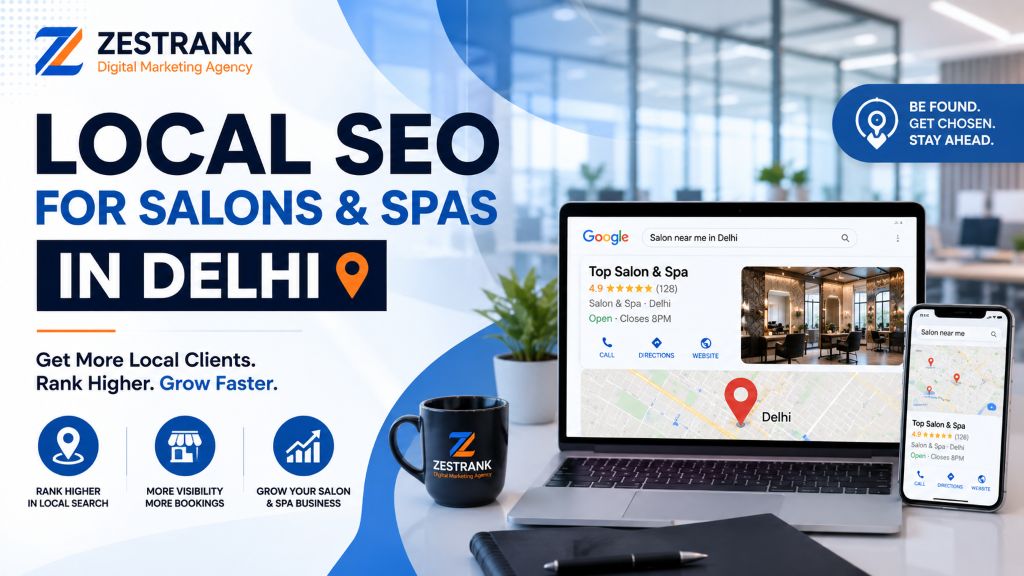
Quick answer: Local SEO for salons and spas in Delhi means optimizing your Google Business Profile with accurate service categories, pricing, and a steady stream of recent client reviews, showcasing real before/after and interior photos, responding to inquiries within minutes rather than hours, and keeping listings consistent across booking platforms — so you appear, and get chosen, when clients search “salon near me” or “[service] in [your area].” In 2026, the same profile work that wins the Google Maps pack also determines whether AI-powered local search surfaces you at all.
Booking a salon or spa appointment is one of the most trust-dependent local decisions someone makes — clients are choosing who touches their hair, skin, or body, often based on a 10-second scan of photos and reviews before they call or book. For salons and spas in Delhi NCR, local SEO isn’t just about visibility; it’s about winning that trust moment before a competitor does, and increasingly, about responding faster than they do once you’ve won it.
Why Salon and Spa Local SEO Is Different
Unlike many local categories, salon and spa searches are heavily influenced by visual proof of quality — clients want to see actual results (haircuts, styling, treatments) before committing, more so than reading detailed service descriptions. This makes photo strategy and review content unusually important compared to other local business types. Google Business Profile signals also carry the single largest share of local Map Pack ranking weight of any category factor, so getting the profile itself right is the foundation everything else builds on.
Step 1: Optimize Your Google Business Profile for Beauty and Wellness Categories
- Choose the most specific primary category — “Hair Salon,” “Nail Salon,” “Day Spa,” “Beauty Salon” — rather than a generic “Salon.”
- Add secondary categories for every relevant service area (e.g., a salon offering both hair and bridal makeup should reflect both; a spa offering massage and facials should list both).
- Fill in the Services section with specific offerings and approximate pricing where possible — clients frequently filter or compare based on this before calling.
- Set accurate hours, including any separate hours for appointment-only services versus walk-ins.
- Add relevant attributes: appointment required, walk-ins welcome, women-only, unisex, parking available.
- Actively monitor and answer the Questions & Answers section on your profile — Google surfaces this prominently, and an unanswered question sitting there for months looks worse than no question at all.
Step 2: Build a Strong, Authentic Photo Library
This is the single highest-impact area for salons and spas specifically.
- Upload real before/after photos (with client permission) showing actual results — these convert far better than stock or generic interior photos alone.
- Add interior and ambiance photos so prospective clients know what to expect, particularly important for spas where atmosphere matters to the decision.
- Showcase your team and their specialties where relevant — clients often choose a salon based on a specific stylist or therapist they trust.
- Upload new photos weekly, not occasionally — this is the single most repeated recommendation across current salon SEO guidance, since Google visibly tracks profile activity and treats inactive profiles as lower priority than actively maintained ones.
Step 3: Build Consistency Across Booking Platforms
Beyond Google, Delhi clients frequently use:
- Salon/spa-specific booking platforms if you use one for appointments — connect it to your Google Business Profile’s “Book” button where possible, so clients can book directly from the search result without an extra step.
- Justdial and Sulekha for initial discovery and reviews.
- WhatsApp, which functions as a de facto booking channel for a large share of Delhi salons and spas — see our guide to WhatsApp Business marketing for small businesses in India if you’re not yet using it as a structured booking channel.
Keep your salon name, address, phone number, and core service list consistent across all platforms — conflicting information (different hours, different services listed, even “St.” vs. “Street”) confuses Google’s matching and creates hesitation at the exact moment a client is deciding to book.
Step 4: Generate Reviews Consistently and Respond Thoughtfully
Reviews for salons and spas often go into far more specific detail than other categories — which stylist they saw, which treatment they got, how the result looked weeks later.
- Ask satisfied clients for a review right after their appointment, ideally as they’re paying or leaving, when satisfaction is highest.
- Encourage (without scripting) clients to mention specific services or staff members — this level of detail helps future clients make a more confident decision and strengthens relevance signals to Google.
- Respond to every review, particularly negative ones — for a trust-heavy category like this, a calm, specific, non-defensive response to a complaint matters significantly.
- Prioritize recency, not just volume. A profile with 40 reviews from three years ago consistently performs worse in both rankings and conversion than one with 15 reviews from the last two months — a steady drip of recent reviews matters more than a large but stale total. For a full playbook on this, see how to get more Google reviews.
Step 5: Respond to Inquiries Within Minutes, Not Hours
This is the biggest gap in most salon local SEO advice, and the one with the most direct revenue impact. The average business takes nearly two full days to respond to an inbound lead — for salons specifically, this is a structural problem, since you can’t check messages while you’re with a client. Conversion drops sharply as response time moves from minutes to half an hour, and the salon that responds first to a high-intent local inquiry wins the booking the large majority of the time.
- Set up automated instant acknowledgment (even a simple “Thanks for reaching out, we’ll confirm your slot shortly”) for messages that arrive while you’re with clients — WhatsApp Business’s quick-reply and away-message tools handle this well.
- Assign a specific staff member or reception rotation to check and respond to Google messages, Instagram DMs, and WhatsApp inquiries between appointments, not just at the end of the day.
- If your inquiry volume justifies it, an AI-assisted response tool that handles routine booking questions (availability, pricing, services) can close the gap between a message arriving at 9pm and a human seeing it the next morning.
Step 6: Create Service-Specific Website Content
If you have a website, avoid relying on one general “Services” page covering everything thinly.
- Create dedicated content for higher-value or signature services (“Keratin Treatment in Saket” rather than burying it in a generic services list).
- Mention your specific neighborhood and nearby landmarks naturally to reinforce “near me” relevance.
- If you have multiple branches, give each its own dedicated page with location-specific details.
Step 7: Use Google Posts for Offers and New Services
- Post seasonal offers, new service launches, or limited-time packages using Google Business Profile Posts.
- Include a clear call-to-action (“Book Now,” “Call to Schedule,” “DM for Availability”).
Step 8: Show Up in AI-Powered Local Search, Not Just the Map Pack
AI-powered search features now influence a majority of local business discovery decisions, alongside traditional Google search. The practical upside for salon owners: the same profile completeness, review recency, and photo activity that improve your Map Pack ranking are also what AI search systems pull from to answer questions like “best salon for balayage near me” — there’s no separate playbook to learn. If you want to understand how this connects to search more broadly, our AI search optimization page covers the fuller picture beyond just local listings.
Use Short-Form Video to Support Discovery
Short-form video — Instagram Reels, YouTube Shorts — has become one of the fastest-growing salon marketing channels, largely because it does the same “visual proof of quality” job as before/after photos, just in motion. A quick transformation clip or a behind-the-scenes styling Reel often outperforms a static photo post for reach. If you’re building this out, our Instagram algorithm 2026 breakdown covers what actually drives visibility on Reels specifically.
Common Mistakes Salons and Spas Make With Local SEO
- Generic primary category that doesn’t reflect specific specialties (hair vs. skin vs. full-service spa)
- Relying solely on stock or low-quality photos instead of real client results
- Inconsistent pricing or service lists across Google, Justdial, and the salon’s own website
- Ignoring negative reviews instead of responding calmly and specifically
- Letting reviews go stale — a large historical count with nothing recent looks worse to both clients and Google than a smaller, active one
- No mention of specific signature services anywhere online, making it hard to rank for anything beyond the generic business name
- Slow response times on messages and inquiries, losing bookings to whichever competitor replies first — often the single most fixable, highest-revenue-impact mistake on this list
Final Thoughts
Salon and spa local SEO rewards authentic visual proof, consistent and recent reviews, and fast response times more than almost any other set of local SEO levers combined. Clients are making a trust-based decision quickly, and a complete, photo-rich, actively maintained, and promptly-answered profile is often the deciding factor between a booked appointment and a scroll to the next listing. If you run a different kind of local business, the same core principles apply — see our guides for restaurants and clinics in Delhi, or our broader top 10 local SEO tips for Delhi NCR businesses.
Want this set up properly for your salon or spa?
ZestRank offers specialized local SEO services in Delhi for beauty and wellness businesses — from Google Business Profile optimization to review generation systems built around your specific services. See our full Google Business Profile optimization guide or our case study on scaling a local business’s leads by 410% for a sense of what this looks like in practice. If you’re not showing up for “near me” searches at all right now, start with why your business isn’t showing up in near me searches. Get a free local SEO audit for your salon or spa today.
Frequently Asked Questions
How important are before/after photos for salon local SEO?
Extremely important — they’re often the single biggest factor in a prospective client’s decision to book, more so than written service descriptions, since they provide direct visual proof of quality.
Should each stylist or therapist have their own online presence?
For salons where clients frequently book based on a specific stylist’s reputation, individual social media profiles (linked from the main salon profile) can help, though the main Google Business Profile should remain the primary, complete listing for the business itself.
How often should a salon update its Google Business Profile photos?
Weekly updates with fresh work examples keep the profile signaling as active, which supports both client trust and Google’s view of profile relevance and engagement.
Can a new salon compete with long-established ones in local search?
Yes — Google Maps ranking depends on relevance, distance, and prominence rather than how long a business has operated. A new salon with a complete profile, strong authentic photos, and a steady stream of detailed, recent positive reviews can outrank an established but neglected competitor.
Does response time to inquiries actually affect local SEO, or just conversion?
Response time primarily affects conversion rather than ranking directly, but its revenue impact is often larger than any ranking factor on this list — a salon that ranks #1 but responds to inquiries hours later can still lose the booking to a lower-ranked competitor who replies within minutes.
Do salons need to worry about AI search tools like AI Overviews or ChatGPT, or just Google Maps?
Both, though not as separate work — the profile completeness, review recency, and consistent listings that improve your Google Maps ranking are largely the same signals AI-powered search features draw from when answering local queries, so there’s no separate strategy required, just consistent execution of the fundamentals.
Have a question about this post? Message Rohit directly on WhatsApp or book a free strategy call. For more breakdowns like this, browse the ZestRank blog, or learn more about our team.
About the Author: Rohit Nandan
Founder & Lead Digital Marketing ConsultantRohit Nandan is ZestRank's Founder & Lead Digital Marketing Consultant and YouTube SEO Expert, with over 15 years of experience diagnosing and running search campaigns for businesses across Delhi NCR. He personally reviews ZestRank's client projects, with deep expertise in technical SEO infrastructure and YouTube optimization. Have a question about this post? Message Rohit directly on WhatsApp.
Free Consultation
Ready to see how these exact parameters can be configured to expand your physical business discovery indices?
Request Strategy Call WhatsApp Strategist