How Long Does SEO Take to Show Results in India? (2026 Realistic Timeline)
Rohit Nandan
Founder & Lead Digital Marketing Consultant
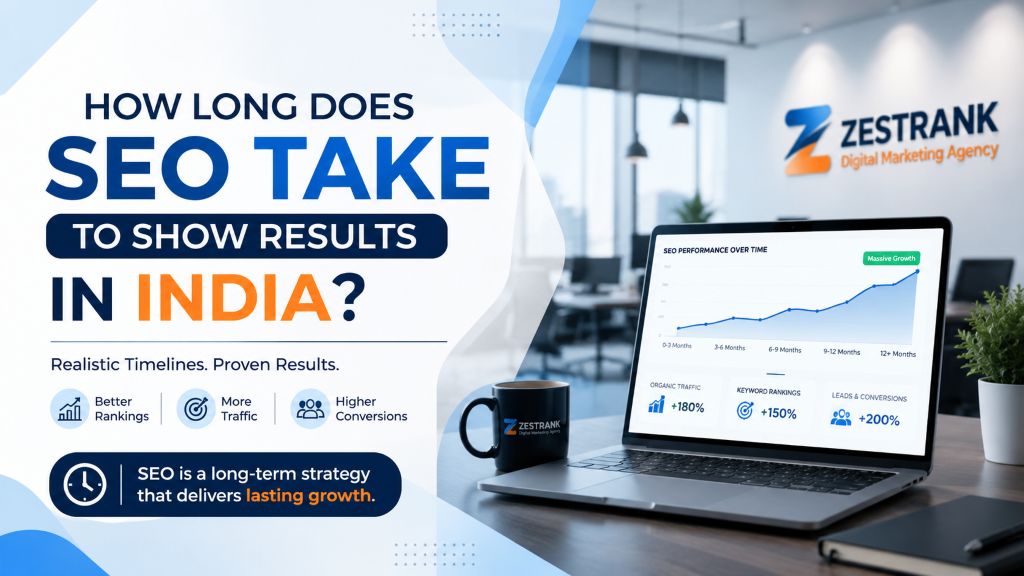
Quick answer: For most low-to-medium competition keywords in India, SEO takes 3–6 months to show measurable results and 6–12+ months to reach strong, revenue-driving rankings — longer in fiercely contested categories like Delhi NCR digital marketing, real estate, or BFSI (banking/finance). Local SEO (Google Maps/local pack) usually moves faster, often within 6–12 weeks. In 2026, a second track matters too: how quickly your content starts appearing in Google AI Overviews, which can happen before you rank in the traditional top 10.
This is one of the first questions every business asks before committing budget to SEO — a fair question, since unlike PPC, you’re paying before you see returns. The honest answer depends on your competition, your site’s current technical and authority baseline, and how consistently you invest in content. Below is a realistic, month-by-month breakdown, updated for how SEO actually works in India in 2026.
Why SEO Doesn’t Work Instantly
Google has to crawl your changes, evaluate your content against everything else already ranking for that query, and build enough trust in your site to rank it above established competitors. New sites in particular go through what’s informally called the “sandbox” period, where even well-optimized pages take time to gain traction regardless of how good the on-page work is.
Independent data backs this up: Ahrefs’ analysis of newly published pages found that the vast majority never reach the top 10 within their first year — content quality and site authority both have to compound over time, not just be “correct” once. You can read more about how Google actually processes and ranks content in Google’s own guide to how Search works.
A Realistic SEO Timeline, Month by Month
| Timeframe | What’s happening | What you’ll actually see |
|---|---|---|
| Months 1–2 | Technical SEO fixes (speed, indexing, mobile usability), keyword research, on-page optimization begins | Minimal ranking movement — this phase is foundational, not result-generating |
| Months 3–4 | New content gets indexed and starts appearing for long-tail, lower-competition terms; Google Business Profile and citation work often shows early Maps movement | Search Console impressions start climbing, even before clicks or top rankings follow |
| Months 5–6 | Pages targeting medium-competition keywords begin landing on page 1–2 | Noticeable organic traffic increase over baseline; first SEO-driven leads for many businesses |
| Months 7–12 | Rankings for competitive terms keep improving as domain authority builds; earlier content keeps climbing without fresh investment | SEO becomes a steady, growing share of leads — usually at a lower cost-per-lead than paid channels |
The AI Overviews Factor: Why 2026 Timelines Look Different
This is the biggest shift since the original version of this playbook. As of mid-2026, Google’s AI Overviews now appear on more than 20% of searches, and click-through rates drop by nearly 60% when they do — meaning a growing share of queries end without a click at all as users get their answer directly on the results page. That doesn’t mean SEO stopped working — it means “results” now show up in more places than the traditional blue links:
- Citations inside AI Overviews, even if the user never clicks through
- Faster visibility for well-structured content — pages with clear answer-first headings, FAQ sections, and schema markup can get pulled into AI Overviews before they crack the top 10 organically
- Local prominence in map-based and voice results, which behaves more like local SEO’s faster timeline than classic organic SEO
One important India-specific nuance: the AI Overview and zero-click rates quoted above are typically measured on US search traffic. Independent analysis suggests India currently sees somewhat lower zero-click rates than the US, since Google has tended to serve lighter, more traditional results in markets with higher mobile data costs and more varied device/network conditions — AI Overviews are more data- and processing-intensive to render. This gap is expected to narrow as infrastructure improves and the feature rolls out more broadly, but it means Indian businesses may have a slightly longer runway before AI Overview visibility becomes as decisive a factor as it already is in the US.
Practically, this means content built for AI extraction (short, direct answers near the top; structured FAQs; clear headings) can produce visibility on a faster track than waiting for a page-one ranking. It’s a genuinely different metric to watch alongside rankings — not a replacement for them. If you want a deeper look at how this is reshaping SEO work generally, we broke it down in SEO Didn’t Die in 2026 — It Became Digital PR and Generative Engine Optimization (GEO) Explained.
Why India Adds Its Own Variables to the Timeline
SEO timelines aren’t identical everywhere, and India has a few characteristics worth knowing before you set expectations:
- Google dominance is near-total. Google holds well over 95% of search market share in India — far higher than the US or Europe — so unlike some Western markets, you don’t need a multi-engine strategy. Every optimization decision can be made with Google’s guidelines as the single source of truth.
- India is mobile-first, aggressively. Mobile accounts for the large majority of search queries in India, well above the global average. Sites that are slow or clunky on mobile lose ranking momentum faster here than in markets with more balanced desktop usage — technical mobile performance isn’t optional, it’s foundational to the Months 1–2 phase above.
- Metro competition is intense, tier-2/3 competition is thinner. In Delhi NCR — Delhi, Noida, Gurugram, Ghaziabad — competition for commercial keywords (digital marketing, real estate, finance, legal) is some of the toughest in the country, pushing realistic timelines toward the 6–12 month end. Businesses targeting less-contested tier-2 and tier-3 cities, or long-tail local intent, often see movement noticeably faster.
- Regional and Hindi-language search is a growing, underused opportunity. Many businesses only optimize English content, leaving Hindi and regional-language search demand largely uncontested — often a faster path to visible rankings than fighting for English keywords head-on.
Timeline by Industry
Not every industry moves at the same pace, even within India. A general guideline:
| Industry | Typical timeline to meaningful results | Why |
|---|---|---|
| Local services (salons, clinics, home services) | 6–12 weeks | Driven mostly by Google Business Profile and reviews |
| E-commerce (non-competitive niches) | 4–6 months | Product/category pages index and rank faster than YMYL content |
| B2B / SaaS | 5–8 months | Longer buying cycles, lower search volume, but less head-to-head competition |
| Real estate | 6–10 months | High commercial competition, especially in NCR |
| Finance / BFSI | 8–12+ months | YMYL category — Google applies the highest trust bar; E-E-A-T signals matter heavily |
| Healthcare | 8–12+ months | Also YMYL; requires demonstrable expertise and authoritative backlinks |
Why Local SEO Often Moves Faster Than Organic SEO
Google Maps and local pack rankings depend heavily on Google Business Profile completeness, citation consistency, and review velocity — all factors you can influence directly and that can start moving rankings within weeks, rather than the months typically needed to build broader domain authority for competitive organic keywords. For the full breakdown of what actually moves the needle here, see our Google Maps ranking guide.
Factors That Speed Up or Slow Down Results
Speeds things up:
- Starting with an established domain that already has some existing authority and backlink history
- Targeting lower-competition, specific long-tail keywords first, then expanding
- Consistent content publishing rather than sporadic bursts
- A technically healthy, fast, mobile-optimized site from the outset
- Content structured for both traditional ranking and AI Overview extraction (clear headings, FAQs, schema)
Slows things down:
- A brand-new domain with no history or backlinks
- Targeting only broad, highly competitive keywords from day one
- Inconsistent or paused content efforts
- Unresolved technical issues blocking proper crawling and indexing
- Ignoring mobile performance in a market where mobile search dominates
SEO vs. PPC: Setting the Right Expectations
Because this question so often comes up when businesses are choosing where to put their first marketing budget, it’s worth being direct: PPC produces traffic the moment campaigns go live, while SEO compounds over months. Neither is “better” in isolation — they solve different problems. Many businesses run PPC to generate leads while SEO builds in the background, then gradually shift budget toward organic as rankings mature and cost-per-lead drops.
How to Actually Track Whether It’s Working
Waiting blindly for rankings is a common reason businesses abandon SEO too early. Track leading indicators from month one:
- Google Search Console — impressions and average position, updated weekly; this moves long before traffic does
- Google Analytics 4 — organic sessions, engaged sessions, and goal completions from organic traffic
- A rank tracker for your priority keyword set, checked monthly, not daily (day-to-day fluctuation is normal and not meaningful)
- Google Business Profile Insights, for local SEO — views, calls, and direction requests are visible well before organic traffic climbs
All of the above are free — see our Top 10 Free SEO Tools guide for direct links to each one, plus a few more worth setting up alongside them.
What If an Agency Promises Results in 30 Days?
Be cautious. Some early movement — especially in local SEO — can appear within weeks, but any agency guaranteeing page-one rankings for competitive keywords in 30 days is either misunderstanding how Google’s evaluation process works or using short-term tactics that risk penalties later. A reputable SEO company in Delhi — or anywhere — sets realistic expectations rather than promising shortcuts. As seen on DesignRush, agencies that make it onto vetted industry rankings are typically the ones being evaluated on actual client results and process transparency, not overnight-ranking promises — a useful sanity check when you’re comparing agencies.
Final Thoughts
SEO is a compounding investment, not an instant channel — and that’s exactly what makes it valuable over time. Businesses that understand this realistic timeline, track the right leading indicators, and stay consistent through the slower early months are the ones who reach the more efficient, lower-cost results that typically arrive from month six onward — in both traditional rankings and, increasingly, AI-generated search results.
Want a timeline specific to your business, city, and competition?
ZestRank offers SEO services in Delhi, Noida, Gurugram, and Ghaziabad with transparent, month-by-month reporting — no inflated promises about overnight rankings. If your content also needs to show up in ChatGPT, Gemini, and Google’s AI Overviews, our AI Search Optimization service covers that alongside traditional SEO. Need faster visibility while SEO builds? We also run PPC management to bridge the gap. Book a free SEO consultation and get an honest, industry-specific projection.
Frequently Asked Questions
Can SEO show results faster than 3 months?
In low-competition niches or for local SEO specifically, some movement can appear within 6–8 weeks. For most medium-to-high competition keywords, 3–6 months remains a more realistic expectation for meaningful ranking improvement.
Does a bigger budget make SEO results appear faster?
A larger budget can accelerate certain aspects — more content produced faster, quicker technical fixes, faster link-building outreach — but Google’s own crawling, indexing, and trust-building process still applies regardless of spend. Budget speeds up your effort; it doesn’t speed up Google’s evaluation timeline.
Why did my rankings drop after initially improving?
Temporary fluctuations are normal as Google continues evaluating new content and pages settle into position. Sustained drops are more often linked to algorithm updates, technical issues, or increased competition, and are worth investigating specifically rather than dismissing as normal volatility.
Is local SEO faster than regular organic SEO in India?
Generally yes — Google Business Profile and Maps rankings often respond to optimization within weeks, while broader organic rankings for competitive keywords typically take several months to build meaningfully.
How much does SEO cost in India, and does that change the timeline?
Costs vary widely by city, competition, and scope, but a bigger retainer buys more consistent output (content, technical fixes, outreach) — it doesn’t buy a faster crawl or trust-building cycle from Google. Consistent, moderate investment over 6–12 months typically outperforms a large short-term spend.
How do Google’s AI Overviews change how long SEO takes?
They add a second, sometimes faster track. Content structured with clear answers, FAQ sections, and schema markup can get pulled into AI Overviews before it ranks in the traditional top 10 — but sustained organic visibility still follows the same months-long trust-building timeline described above.
About the Author: Rohit Nandan
Founder & Lead Digital Marketing ConsultantRohit Nandan is ZestRank's Founder & Lead Digital Marketing Consultant and YouTube SEO Expert, with over 15 years of experience diagnosing and running search campaigns for businesses across Delhi NCR. He personally reviews ZestRank's client projects, with deep expertise in technical SEO infrastructure and YouTube optimization. Have a question about this post? Message Rohit directly on WhatsApp.
Free Consultation
Ready to see how these exact parameters can be configured to expand your physical business discovery indices?
Request Strategy Call WhatsApp Strategist