Why Can’t Buyers Find Your San Francisco Startup in ChatGPT? (The SEO Playbook for SaaS, Neighborhoods and AI Search)

Rohit Nandan
Founder & Lead Digital Marketing Consultant
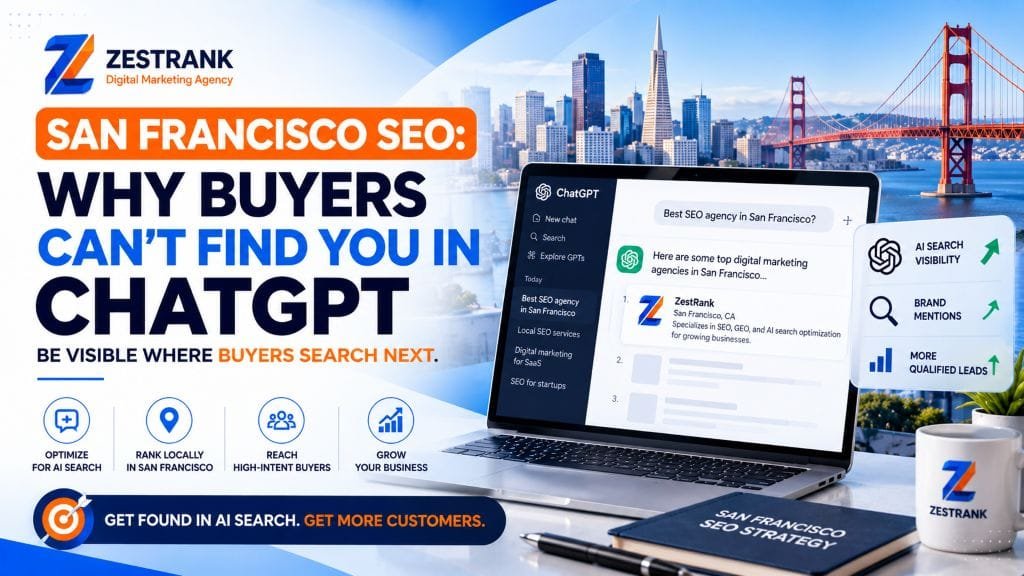
Quick answer: “SEO in San Francisco” is really three different problems. B2B and AI startups need bottom-of-funnel pages, crawlable documentation and mentions on the sites AI assistants learn from, because their buyers ask ChatGPT before they ask Google. Neighborhood businesses compete block by block in the map pack. And everyone has to measure results under California privacy rules, which can reduce the analytics data you see. Most guides blur these together. Decide which problem is yours first. Published US estimates for small-business SEO cluster around US$1,000 to $3,000 a month, with competitive categories higher.
A founder opens ChatGPT and types: “best customer data platform for a 30-person Series A company.” Five tools come back. Hers isn’t one of them. She checks Google, where her site ranks on page one for a product keyword, and realises the buyer never got that far.
This is the quiet shift in San Francisco’s software market. The buyers are early adopters of AI tools, and the shortlist often forms before a single search result is clicked. Meanwhile, a café owner in the Mission is worried about something completely different. Same city, same word “SEO”, almost no overlap. Let’s separate them.
How Do San Francisco Buyers Actually Research? {#research}
For software and services, the journey usually mixes several channels: an AI assistant for a first shortlist, Google for comparison and pricing pages, review sites for social proof, and peers or communities for the final check. For local consumers, it’s the map pack, reviews and increasingly a quick question to an AI tool.
The practical consequence is that “ranking #1” is no longer the whole game. You need to be findable (crawlable, well structured), understandable (clear about what you do and for whom) and mentioned (named by sources AI tools and buyers trust). Google itself says its AI features need no special optimization beyond sound SEO. The extra work is in the signals beyond your own website.
What Should a SaaS or AI Startup Do First? {#b2b}
Start with the pages closest to a purchase decision. Blog volume feels productive and converts poorly. These convert:
- Comparison pages (“[Your product] vs [Competitor]”): honest, specific, with real differences. Buyers who search these are already evaluating.
- Alternatives pages (“[Competitor] alternatives”): captures people unhappy with an incumbent.
- Use-case and integration pages: one page per real workflow or integration, with enough detail that a buyer can picture adopting it.
- A clear pricing page: buyers punish vagueness, and AI tools quote what they can find.
- Crawlable documentation: if docs sit behind a login or load only through scripts, neither search engines nor AI crawlers can read them.
Then check the plumbing. Make sure robots.txt and any security or CDN setting aren’t blocking AI crawlers, because a block makes everything else irrelevant. Our AEO playbook has the 30-second check. For the wider strategy, see our B2B SaaS SEO strategy guide and SEO for SaaS companies page.
How Do You Get Mentioned Where AI Tools Look? {#mentions}
Studies of AI citation consistently point the same way: what other sites say about you often carries more weight than what you say about yourself. For a startup, that means building a footprint outside your domain:
- Review platforms where buyers in your category look, with a steady stream of genuine reviews
- Third-party roundups and comparison articles that name your product
- Community discussion where users talk honestly about tools in your space
- Video demos and walkthroughs, since video platforms are heavily cited
- Founder and customer stories on credible publications
Run a quick brand gap test. Ask ChatGPT, Gemini and Perplexity ten questions your buyers would ask, such as “best [category] for [company size]”, “[competitor] alternatives” and “[your product] vs [competitor]”. Record who is named, in what order, and with what description. If you’re missing or described inaccurately, you’ve found your work. Our GEO guide explains why mentions matter and how the retrieval process works.
Be wary of anyone who promises a guaranteed placement in AI answers. Nobody controls that, and results vary by prompt, user and time.
What About San Francisco’s Neighborhood Businesses? {#neighborhoods}
For restaurants, clinics, studios and shops, San Francisco is a patchwork of neighborhoods, and people search with one in mind: the Mission, SoMa, Hayes Valley, the Marina, the Sunset, the Richmond. Map results change block by block.
What moves the needle:
- Get the basics exactly right. Primary category, hours, services, photos and attributes. Hours matter more than people think, because a profile showing the wrong closing time costs you walk-ins and reviews.
- Build reviews steadily. Recency and responses matter as much as raw count. See our guide to getting more Google reviews.
- Write for the neighborhoods you truly serve. Use real detail such as cross streets and transit, not a template with a swapped name.
- Remember the languages. Many San Francisco residents search in Chinese or Spanish. If your customers do, that’s a separate research task, not a translation job.
- Mind the tourist-versus-resident split. Visitors and locals search differently, so decide who you’re serving.
For setup, current verification requirements and common mistakes, see our Google Business Profile guide and our local SEO service page.
How Do California Privacy Rules Affect SEO Measurement? {#privacy}
California’s privacy law, the CCPA as amended by the CPRA, gives residents rights over how their data is collected and shared. The California Attorney General’s CCPA page explains the rules. For marketers, the practical effect is that consent banners and opt-outs can reduce how much visitor data your analytics captures, so dashboards may under-report traffic and conversions.
That doesn’t make SEO unmeasurable. It changes what you should trust:
- Prioritise leads over sessions. Form submissions, demo requests and calls tracked in your CRM are more reliable than traffic counts.
- Fix tracking gaps rather than assuming demand fell. Our guide to server-side tracking for Google Ads and GA4 explains one common fix.
- Ask “how did you hear about us?” on every form. It catches customers who saw you in an AI answer and searched your name later.
- Confirm your consent setup with a legal adviser. This is marketing guidance, not legal advice.
What Mistakes Do San Francisco Businesses Make? {#mistakes}
- Treating local SEO as relevant to a SaaS company that sells nationally
- Publishing dozens of generic blog posts instead of a few strong comparison pages
- Blocking AI crawlers by accident through security settings
- Ignoring review platforms and community mentions
- Copying one neighborhood page across several areas
- Measuring traffic alone when consent choices distort the numbers
- Buying a package without asking what’s delivered each month
What Do These Look Like in Practice? {#example}
A B2B example. Imagine a data-analytics startup selling to mid-sized companies. (Hypothetical.) Its blog has forty generic posts, and its product page ranks for almost nothing. A better first quarter might look like this: confirm AI crawlers can reach the site; write two honest comparison pages against the two incumbents buyers mention most; add a pricing page with clear tiers; make the documentation crawlable; collect a handful of genuine reviews on the platforms buyers use; then run the ten-prompt brand gap test again after eight weeks to see whether anything has changed. The shift is from volume to decisiveness: fewer pages, each closer to a buying decision.
A neighborhood example. Imagine a small boutique in Hayes Valley. (Hypothetical.) Its profile lists the wrong closing hour on weekends, shows one old photo and has no recent reviews. The fix is unglamorous: correct hours, add recent photos of the storefront and bestsellers, ask recent customers for reviews that mention the neighborhood, and post weekly about new arrivals. Those four habits often matter more than anything technical, because they affect both ranking and whether a passer-by walks in.
What both have in common is that they start from what buyers actually do, not from a generic checklist.
What Does SEO Cost in San Francisco? {#cost}
Published estimates come mostly from agencies and vary widely. Small businesses commonly see roughly US$1,000 to $3,000 a month, and the Bay Area’s competitive categories tend toward the upper end or beyond. Scope matters more than the headline figure. A B2B retainer with comparison pages, technical fixes and off-site work looks very different from a local-only plan. Ask for an itemised scope, named deliverables and reporting tied to pipeline or bookings.
Can an India-Based Agency Work With San Francisco Companies? {#remote}
ZestRank is based in Noida, India, and works remotely. We have no San Francisco office. A 9am Pacific call falls in our late evening, so most work runs asynchronously, with written reports and recorded walkthroughs, which suits many software teams already used to remote work. If you want an in-person team, choose a local agency. If you’re an agency yourself, our white-label SEO program is built for that. Either way, ask how a provider learns your market.
A 90-Day Plan {#plan}
| Period | SaaS and AI startups | Neighborhood businesses |
|---|---|---|
| Days 1 to 30 | AI crawler check, technical audit, brand gap test | Profile audit, hours and category fixes, tracking |
| Days 31 to 60 | Two comparison pages, one alternatives page, docs fixes | Review system, neighborhood pages |
| Days 61 to 90 | Review-site and community outreach, pricing page | Photos, posts, first results review |
The Bottom Line
San Francisco punishes generic SEO. Pick your problem, build for the buyers who actually research the way yours do, and measure with methods that survive consent banners.
Want a plan scoped to your problem?
See our SEO services in San Francisco or book a free strategy session. Selling in the Pacific Northwest too? Our Seattle SEO page covers that market.
FAQs {#faqs}
Why doesn’t my startup appear in ChatGPT answers?
Usually because AI tools can’t find enough clear, consistent information about you, or because competitors are mentioned more on sites they trust. Fix crawl access, clarify your pages and build mentions off your site.
Do SaaS companies in San Francisco need local SEO?
Usually not. Their buyers are national or global, so comparison pages, product content and AI-answer visibility matter more than the map pack.
Does California privacy law stop me tracking SEO results?
No, but consent choices can reduce analytics data. Track leads, fix tracking gaps and confirm your consent setup with a legal adviser.
Can anyone guarantee I’ll appear in AI answers?
No. A good provider can improve your chances, but placement depends on factors nobody controls.
Can an agency outside the Bay Area do San Francisco SEO?
Yes for technical, content and reporting work. Ask how they research your market and where your working hours overlap.
About the Author: Rohit Nandan
Founder & Lead Digital Marketing ConsultantRohit Nandan is ZestRank's Founder & Lead Digital Marketing Consultant and YouTube SEO Expert, with over 15 years of experience diagnosing and running search campaigns for businesses across Delhi NCR. He personally reviews ZestRank's client projects, with deep expertise in technical SEO infrastructure and YouTube optimization. Have a question about this post? Message Rohit directly on WhatsApp.
Free Consultation
Ready to see how these exact parameters can be configured to expand your physical business discovery indices?
Request Strategy Call WhatsApp Strategist