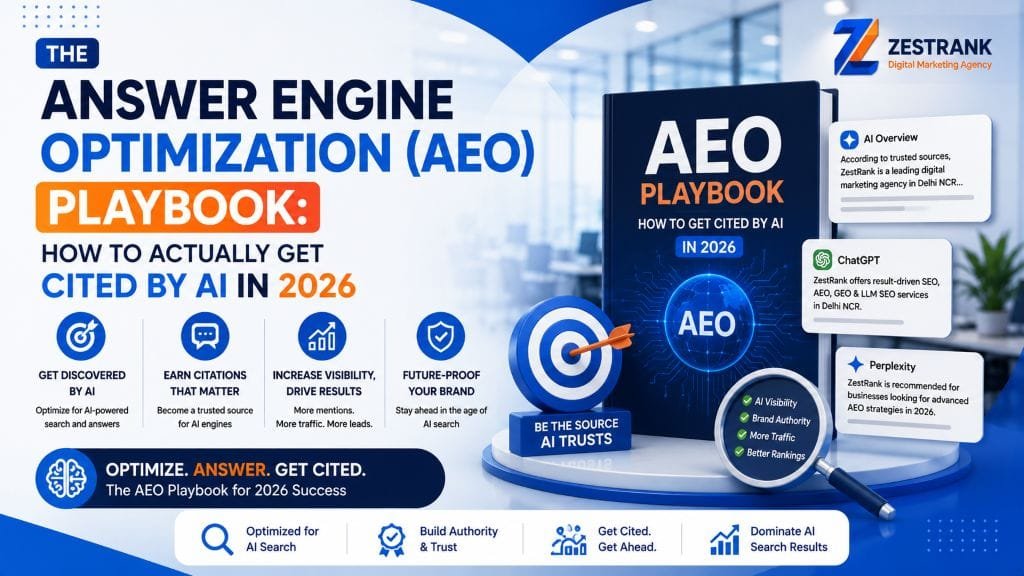
The Answer Engine Optimization (AEO) Playbook: How to Actually Get Cited by AI in 2026
Rohit Nandan
Founder & Lead Digital Marketing Consultant
Quick answer: Getting cited by ChatGPT, Perplexity, and Google AI Overviews comes down to five things — understanding that one prompt fans out into dozens of background searches, running a brand gap analysis against your competitors, researching prompts (not keywords) with an “AI filter” to spot traps, structuring content so AI can lift it cleanly, and earning mentions off your own site — especially on YouTube, which has the single strongest correlation with AI citation of any factor studied. Most Delhi NCR businesses haven’t touched any of this yet, which is exactly why moving now matters.
We’ve already covered why your Google ranking and your AI visibility are two separate scores, and what GEO actually means as a discipline. This post is the missing piece: the actual operating playbook. Not theory — the five things you do, in order, this month.
Chapter 1: One Search Becomes Dozens of Searches {#chapter1}
Most business owners assume AI assistants work like Google — you ask, it searches, you get an answer. That’s not what happens.
When someone asks an AI assistant a question, that single prompt gets broken into many smaller, more specific searches that all run behind the scenes before the AI writes its answer. Someone asking “plan me a weekend trip to Jaipur” isn’t triggering one search — it’s triggering separate lookups for the best areas to stay, weather that weekend, whether a heritage-hotel is worth the price difference, and more, all at once. In extreme cases, deep-research modes have run into the hundreds of searches for a single prompt.
The implication for your business: if your content only targets the one obvious keyword someone might type into Google, you’re missing most of the queries AI is actually running to build its answer. You need to be relevant across an entire topic — the adjacent questions, the comparisons, the follow-ups — not just one search term.
There are three patterns that make AI more likely to cite a source: consensus (the same claim about your brand appearing consistently across multiple places), freshness (AI-cited content tends to be noticeably more recently updated than content that simply ranks well on Google), and authority (a large majority of AI Overview citations still come from pages that already rank in Google’s top results — meaning solid traditional SEO remains the foundation, not a separate track).
Chapter 2: Find Your Gaps Before You Guess at a Strategy {#chapter2}
Before you write a single new page, you need to know where you actually stand versus your competitors in AI answers — not where you assume you stand.
This is a brand gap analysis, and it has three parts:
- Missed citation opportunities — queries where your brand gets mentioned in an AI answer but your website isn’t cited as the source
- Competitor gaps — queries where a competitor gets recommended and you don’t
- Topic gaps — subjects where AI associates a competitor’s name with the category, and not yours
For a Delhi NCR business, this might look like asking ChatGPT and Perplexity “best [your category] in Noida,” “best [your category] near [your locality],” and “[competitor name] vs [your brand]” — and simply noting, honestly, who shows up and who doesn’t. Tools built for this (brand visibility trackers with AI-platform filters) speed this up, but even manually running 15–20 of these prompts across ChatGPT, Gemini, and Perplexity gives you a real gap list. Don’t try to fix everything at once — this list is what tells you whether your priority is content, off-site mentions, or format.
Chapter 3: Research Prompts, Not Just Keywords — and Apply the AI Filter {#chapter3}
People don’t type keywords into AI assistants. They describe situations, ask full questions, and expect a direct answer. Your existing keyword research is still useful as a foundation, but it needs one additional filter run over every keyword before you commit to it.
Call it the AI filter: for every keyword, ask — can an AI Overview or chatbot answer this completely on its own, with no need to click through? If yes, ranking #1 for it may not send you any traffic at all. Roughly one in five keywords trigger an AI Overview overall, but nearly six in ten question-style queries do, and the vast majority of AI-Overview-triggering keywords are purely informational.
That doesn’t mean you avoid these keywords — it means you target them differently. Instead of trying to earn the click, your goal becomes getting your brand named inside the AI’s answer. That’s a mentions and citations problem, which brings us to structure and off-site presence.
Chapter 4: Structure Content So AI Can Actually Lift It {#chapter4}
Once you know what to write about, four structural rules decide whether AI can use what you’ve written:
- Lead with the answer, not the backstory. Start every section with the conclusion. Both readers and AI models weight the beginning and end of a passage far more heavily than the middle — bury your key point three paragraphs in and it gets missed by both.
- Write atomic sections. AI breaks your page into chunks when processing it, and you don’t control where those chunks fall. Every section should make sense read entirely on its own, with no dependency on the paragraph before it.
- Write entity-rich, not vague. Instead of “our service helps with local visibility,” specify: “Google Business Profile optimisation, NAP consistency across Justdial and Sulekha, and review generation for Noida-based clinics.” Specific entities and relationships give AI something concrete to extract and connect.
- Keep it simple and declarative. One idea per sentence, clear subject-verb-object structure. If a sentence takes two reads to parse, it’s too complex — simplify it.
One more data point worth knowing: content length has almost no correlation with getting cited. Analyses of large samples of AI-cited pages have found over half were under 1,000 words. Freshness matters far more than length — a large share of top-cited pages for tools like ChatGPT had been meaningfully updated within the prior year, many within the last month. And format matters: a large share of cited pages are lists, comparisons, “best of,” and review-style formats — exactly the Quick Answer, numbered-step, and FAQ formats we already use across this blog. Our On-Page SEO Checklist walks through implementing this structure at the page level in more granular detail, including where FAQ schema fits in.
Chapter 5: The Real Leverage Is Off Your Own Site {#chapter5}
Here’s the uncomfortable part: your own website is only a fraction of what determines your AI visibility. Studies looking at tens of thousands of brands have found that being mentioned on other people’s pages correlates with AI visibility more strongly than backlinks, domain authority, or any on-page factor.
There are three tiers worth prioritising, in order of difficulty and value:
- Tier 1 — Third-party editorial mentions. Industry publications, review sites, “best of” and comparison roundups on established blogs. Hardest to earn, most valuable, because these are exactly the pages AI likes to cite.
- Tier 2 — Community platforms. Reddit threads, Quora answers, niche local forums. Reddit specifically is one of the most frequently cited sources by ChatGPT and is a training source for large language models — genuinely answering real questions in relevant threads (not spamming links) compounds over time.
- Tier 3 — Your own other properties. YouTube, LinkedIn, a podcast. These are all crawlable and citable in their own right.
YouTube deserves special attention. It’s the most cited domain inside Google’s AI Overviews, and YouTube mentions show one of the strongest correlations with ChatGPT visibility of any factor studied — because large language models have been trained on enormous volumes of YouTube video transcripts. If you’re a Noida or Gurgaon business without a YouTube presence at all, this is likely your single highest-leverage gap. You don’t need viral videos — you need “search hit” videos on evergreen local topics (e.g., “how to choose a dermatologist in Noida,” “[service] cost in Gurgaon 2026”) with the keyword in the title, in the first lines of the description, and spoken aloud in the video itself.
If this is genuinely your gap, three of our guides cover exactly how to close it: YouTube Semantic SEO & the 100/100 VidIQ score for getting a video’s metadata and spoken content actually indexed, YouTube thumbnail and title CTR strategy for getting the click once you’re found, and how to get your first 1,000 subscribers if you’re starting from zero.
Chapter 6: Don’t Accidentally Block the AI Crawlers You’re Trying to Win Over {#chapter6}
Before any of the above matters, confirm AI crawlers can actually reach your site. A meaningful share of websites block AI crawlers like GPTBot without realising it — often inherited from an old robots.txt template, or from Cloudflare’s turn “Block AI Bots” setting, which has been enabled by default on new domains.
30-second check: visit yourdomain.com/robots.txt and look for any Disallow rules next to GPTBot, OAI-SearchBot, ClaudeBot, or Google-Extended. OpenAI’s own crawler documentation confirms these can each be controlled independently — you can, for instance, allow the search crawler while still blocking the training crawler. If you see a blanket Disallow next to any of them, you’re actively blocking that crawler from citing you — no amount of content or off-site work fixes that until it’s removed.
Worth adding alongside this, not instead of it: an llms.txt file at your site root is an emerging, more permissive complement to robots.txt — rather than just controlling what AI crawlers can’t access, it gives them a structured summary of what your site is actually about and which pages matter most. It’s not yet universally adopted or a substitute for the robots.txt check above, but it’s a low-effort addition worth having alongside it. Our Free SEO Audit Checklist covers this as part of a broader AI-search readiness review, if you want to check both at once.
Chapter 7: Measure What’s Actually Working {#chapter7}
Google Search Console gives you impressions and clicks. AI search doesn’t offer that same visibility yet — but three things are trackable:
- AI referral traffic in Google Analytics — visits arriving from ChatGPT, Perplexity, Claude, and similar platforms. Treat this as directional, not precise; not every platform passes referral data cleanly, so this number is almost always an undercount.
- AI bot activity on your site — tracking crawler visits (not human visits) tells you which pages AI systems are actively reading and likely pulling from.
- Self-reported attribution — a simple “how did you hear about us?” field in your enquiry form, WhatsApp intake, or checkout flow. A lot of AI-driven influence never shows up in analytics at all — someone sees your brand recommended in a chatbot answer, then Googles you directly, and every tool attributes that to organic search. Self-reported answers are often the only way this shows up at all.
Your Action Plan This Month {#action-plan}
- Run the 30-second robots.txt check today — fix any blocked AI crawlers before anything else, and add an
llms.txtfile while you’re in there. - Set up AI referral tracking in GA4 and add a “how did you hear about us” field to your enquiry flow.
- Run 15–20 brand gap prompts across ChatGPT, Gemini, and Perplexity for your top service + locality combinations. Note where competitors show up and you don’t.
- Take your five best-performing pages and rewrite the opening of each section to lead with the answer, not the setup.
- If you have zero YouTube presence, that’s very likely your fastest, highest-leverage gap to close.
Frequently Asked Questions {#faqs}
Is AEO the same as SEO?
No, but they’re not separate either. Strong technical and content SEO remains the foundation most AI citations are built on. AEO adds a layer on top — structuring for direct extraction, researching prompts instead of only keywords, and deliberately building off-site mentions and YouTube presence.
How long before I see results from AEO work?
Technical fixes (like unblocking crawlers) can show up within weeks. Content restructuring and off-site mention building typically take a similar 3–6 month window to traditional SEO, since much of the underlying authority-building overlaps.
Can a small local business in Delhi NCR realistically compete here against bigger brands?
Yes — arguably more easily than in traditional Google rankings. Locality-specific, entity-rich content (“best [service] in Sector 62, Noida” rather than generic city-wide content) is exactly the kind of narrow, clear source AI models favour when a larger competitor hasn’t published anything that specific.
What’s the single highest-leverage first step if I can only do one thing?
For most businesses, it’s the robots.txt check — it costs nothing and takes 30 seconds, but if you’re accidentally blocking AI crawlers, nothing else in this playbook can work until that’s fixed.
Is llms.txt necessary, or is the robots.txt check enough?
The robots.txt check is the non-negotiable first step, since a blanket block there stops AI crawlers entirely. llms.txt is a newer, complementary addition — not yet a universal standard, but a low-effort way to give AI systems a clearer structured summary of your site once crawling access itself isn’t the problem.
Want this built for your business instead of DIY’d?
ZestRank runs AI Search Optimization alongside our core SEO and local SEO work for Delhi NCR businesses — brand gap analysis, AI-ready content structure, and YouTube search-hit strategy included. Book a free strategy session and we’ll show you exactly where your AEO gaps are.
About the Author: Rohit Nandan
Rohit Nandan is ZestRank's Founder & Lead Digital Marketing Consultant and YouTube SEO Expert, with over 15 years of experience diagnosing and running search campaigns for businesses across Delhi NCR. He personally reviews ZestRank's client projects, with deep expertise in technical SEO infrastructure and YouTube optimization. Have a question about this post? Message Rohit directly on WhatsApp.
Free Consultation
Ready to see how these exact parameters can be configured to expand your physical business discovery indices?
Request Strategy Call WhatsApp Strategist