Can One “New York” Page Really Rank Across Five Boroughs? (The Truth About NYC Local SEO)

Rohit Nandan
Founder & Lead Digital Marketing Consultant
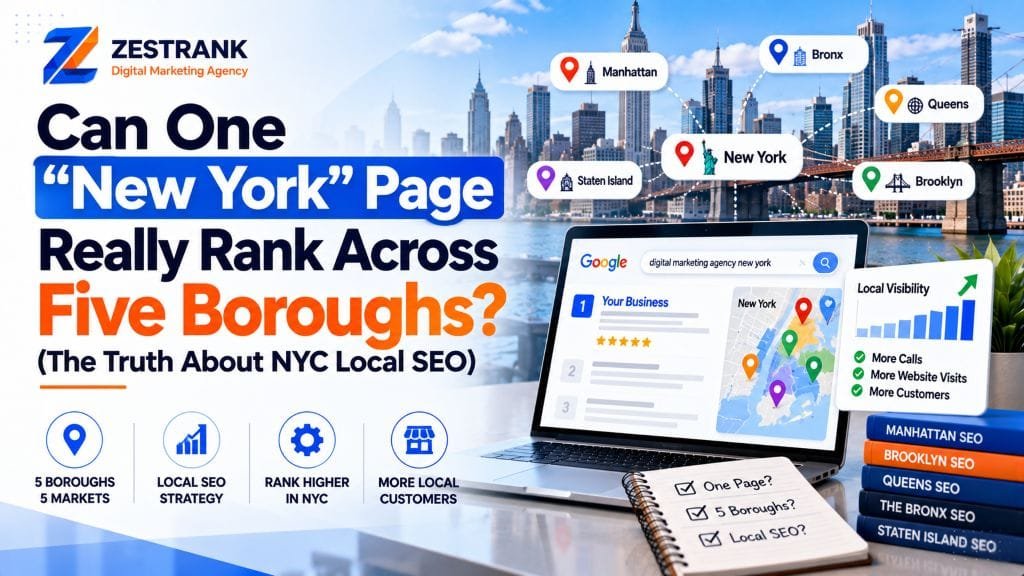
Quick answer: No. New York City is five boroughs and hundreds of neighborhoods, and people search accordingly: by borough, by neighborhood and often by what’s near a subway stop. One generic “New York” page can’t serve all of that, and Google Business Profile rules limit how many locations you can claim, so shortcuts like virtual offices or invented addresses risk suspension. The workable approach is genuine, distinct pages for the areas you truly serve, one accurate profile per real location, extra care in regulated categories like law, finance and healthcare, and measurement by leads. Published US estimates for small-business SEO cluster around US$1,000 to $3,000 a month, with competitive NYC categories often higher.
Imagine a physical therapy practice with one clinic in Park Slope. Its website has a page titled “Physical Therapy in New York.” It ranks nowhere for anything. The owner wonders why, because the practice is good, the reviews are strong and the page mentions “New York” fourteen times.
The answer is that nobody searches for “physical therapy in New York” when they live in Brooklyn and want to get treated near home. They search for their neighborhood, their borough, sometimes their subway line. The page was written for a city that doesn’t behave like one market.
How Do People Actually Search in NYC? {#search}
New Yorkers use geography precisely. The same service gets searched in several ways:
- By borough: “dentist Queens”, “movers Bronx”
- By neighborhood: “Williamsburg”, “Astoria”, “Upper West Side”, “Flushing”
- By transit: “near [station]”, especially for people who don’t drive
- By the broader label: “NYC” and “New York City”, used interchangeably, alongside “Manhattan” used loosely for the whole city by visitors
Daytime population matters too. Midtown and the Financial District fill with workers who search at lunch or after work for things close to the office, while the same streets empty at night. A café near an office tower serves a very different audience from one three blocks into a residential area, and the search patterns reflect it.
Check your own data before assuming. Search Console shows which neighborhood and transit phrases already bring visitors, and that tells you where to build.
How Do You Build Neighborhood Pages That Deserve to Rank? {#pages}
The shortcut is a template: “Plumber in [neighborhood]” repeated across fifty areas with the name swapped. Google’s spam policies treat near-duplicate location pages as a problem, and users can tell the difference immediately. A page earns its place when it contains something a generic one can’t.
For each area you genuinely serve, include:
- Real access information: nearest subway lines, parking realities, building types and entry instructions where relevant
- Local specifics: the streets or blocks you cover, typical building age or layout if it affects your service, local rules that matter (co-op boards, access hours)
- Proof: photos of real work or the real location, and reviews from people in that area
- Clear next steps: hours, how to book, languages spoken
If you can’t write three honest paragraphs about an area, don’t create a page for it. Serve it from a broader page instead. Our local SEO service page explains how we approach multi-area businesses.
What Google Business Profile Mistakes Are Common in NYC? {#gbp}
New York’s density and high rents tempt businesses into shortcuts. Three come up constantly:
- Virtual offices and mailboxes. Google’s guidelines for representing your business require a real location where you operate, and shared or virtual addresses risk suspension.
- One profile covering several boroughs. A profile represents one real location. If you travel to customers, set service areas honestly rather than inventing addresses.
- Keyword-stuffed names. Adding “Best Manhattan Plumber” to your business name violates the guidelines.
If your listing disappears or never appears, a suspension is a likely suspect. Our guide to why you’re not showing up in near-me searches lists the causes, and our Google Business Profile guide covers setup and current verification requirements.
Why Do Law, Finance and Healthcare Need Extra Care? {#regulated}
New York has dense concentrations of law firms, financial firms and healthcare providers. These categories face higher scrutiny from Google for expertise, authority and trust, and they often face professional advertising rules too. That affects how you write:
- Named, credentialed authors. Content on legal, financial or medical topics should show who wrote or reviewed it and why they’re qualified.
- Accurate, current information. Outdated legal or medical content isn’t just unhelpful; it can mislead.
- No overclaiming. Guarantees of outcomes can breach professional rules.
- Careful tracking. Health and financial pages may collect sensitive information, so audit what your tags capture and confirm your setup with your adviser.
See our pages on SEO for legal firms and SEO for financial services. Check any advertising rules with your own compliance adviser; this is marketing guidance, not legal advice.
How Much Do Reviews and Reputation Matter in New York? {#reviews}
A great deal, because choice is overwhelming. With dozens of similar businesses within a few blocks, reviews are often the tiebreaker. Build a steady flow of genuine reviews rather than bursts, respond to each one, and encourage customers to mention specifics such as the service they received and the neighborhood. Never buy or incentivize reviews, because detection is strong and a policy sweep can remove them along with your ranking. Our guide to getting more Google reviews covers the system.
What Should NYC Businesses Do About AI Answers? {#ai}
People ask AI assistants things like “best immigration lawyer in Queens” or “who fixes cracked iPhone screens in Brooklyn”. Run these prompts for your category and neighborhoods, and record who is named and why. Names that appear tend to be consistent across the web, with identical details on directories and well covered by reviews and third-party sources. New York’s large media and publishing scene offers good opportunities for genuine mentions, but earn them with real expertise, not paid placements disguised as editorial. Our AEO playbook and GEO guide explain the method.
What Does a Realistic NYC Example Look Like? {#example}
Imagine a three-dentist practice in Brooklyn. (This is a hypothetical example, not a client.) Its website has one page titled “Dentist in New York”, and its Google Business Profile has the right address but few photos and no services listed. Here’s how a sensible plan would start.
- Read what Search Console already says. Suppose it shows a trickle of clicks for “dentist Park Slope”, “emergency dentist Brooklyn” and “dentist near Atlantic Avenue”. Those are the neighborhoods and phrases real patients use, and they tell you where to build first.
- Build three pages, not thirty. One for Park Slope that names the nearest subway lines, explains building access and lists evening hours. One for emergency dental care that answers the urgent questions first: what counts as an emergency, how quickly you can see someone, and a visible phone number. One for insurance and payment, because that’s what patients ask before booking.
- Fix the profile. Add the primary category and services, real photos of the entrance and waiting area, and a steady request for reviews that mention the treatment and the neighborhood.
- Decide what not to do. Don’t publish a “Dentist in Queens” page if nobody there is realistically going to travel to you.
- Measure the right things. Record calls from the profile and appointment requests for 30 days as a baseline, then compare at 90 days. Rankings are a means; booked appointments are the point.
Notice what’s missing from this plan: volume. It’s a handful of well-built pages aimed at real searches, which is how local SEO usually succeeds in a city this crowded.
Which Mistakes Do NYC Businesses Make Most Often? {#mistakes}
- Writing one page for the whole city. It matches nobody’s actual search.
- Cloning neighborhood pages. Fifty near-identical pages with swapped names are a spam risk and convince no one.
- Using a virtual office address. It can get a profile suspended, and a suspended profile can’t earn calls.
- Ignoring daytime versus night-time audiences. A Midtown business serves office workers at lunch, and a residential block serves families in the evening. Hours, offers and copy should reflect who’s actually nearby.
- Letting reviews stall. A profile with strong reviews from two years ago looks inactive next to one with this month’s.
- Overclaiming in regulated fields. Guarantees of outcomes can breach professional rules, and search engines scrutinize these categories more closely.
- Buying a package without asking what’s delivered. A vague scope is the most common reason SEO disappoints.
What Does SEO Cost in New York City? {#cost}
Published estimates come mostly from agencies and vary widely. Small businesses commonly see roughly US$1,000 to $3,000 a month, and competitive NYC categories such as legal, real estate and healthcare tend toward the upper end or beyond, because the effort needed to compete is higher. Ask for an itemised scope with monthly deliverables, named reporting, and a clear statement of what’s included for each borough or location.
Can an India-Based Agency Work on NYC SEO? {#remote}
ZestRank is based in Noida, India, and works remotely. We have no New York office. A 9am Eastern call lands in our early evening, which means your morning is our end of day. If you want in-person meetings in Manhattan, a local agency may suit you better. If you’re an agency yourself, our white-label SEO program is designed for that. Whoever you hire, ask how they research individual neighborhoods, since that’s where New York SEO is won or lost.
A 90-Day Plan for an NYC Business {#plan}
| Period | Focus |
|---|---|
| Days 1 to 30 | Audit profiles and addresses, remove any risky listings, fix names and categories, review Search Console for neighborhood queries |
| Days 31 to 60 | Build genuine pages for the three or four most valuable areas, start the review system, add credentials and author details |
| Days 61 to 90 | Run AI prompt tests, publish content for your highest-intent searches, review calls and leads against the baseline |
The Bottom Line
New York rewards specificity: real neighborhoods, real locations and real expertise. A generic city page doesn’t compete, and shortcuts with addresses can cost you the listing entirely.
Want an NYC SEO plan scoped to your boroughs and neighborhoods?
See our SEO services in New York City or book a free strategy session. For a different coastal market, see our Miami SEO page.
FAQs {#faqs}
Do I need a page for each borough?
Only for areas you genuinely serve. Each page should contain real, distinct local detail.
Can I list several NYC addresses on Google Business Profile?
Only real, staffed locations. Service-area businesses can set service areas but shouldn’t invent addresses.
Should I include subway stations in my content?
If they match how customers describe your location, yes. Check your Search Console data before assuming.
Is NYC SEO more expensive than elsewhere?
Competition is higher in many categories, which can raise effort and budget, but the right scope matters more than the city.
How long does NYC local SEO take?
Early profile and map improvements can show within weeks to a couple of months. Competitive terms take longer, so judge by calls and leads.
Follow ZestRank on Google
Add ZestRank as your preferred source to see our latest SEO & AI search updates first in Google Search.
About the Author: Rohit Nandan
Founder & Lead Digital Marketing ConsultantRohit Nandan is ZestRank's Founder & Lead Digital Marketing Consultant and YouTube SEO Expert, with over 15 years of experience diagnosing and running search campaigns for businesses across Delhi NCR. He personally reviews ZestRank's client projects, with deep expertise in technical SEO infrastructure and YouTube optimization. Have a question about this post? Message Rohit directly on WhatsApp.
Free Consultation
Ready to see how these exact parameters can be configured to expand your physical business discovery indices?
Request Strategy Call WhatsApp Strategist
- Ultra-fast NVMe storage & LiteSpeed cache
- Free domain, SSL & daily backups
- Extra 10% off with coupon: 1ROHIT89
Starts at ₹139/mo* • 30-day money-back guarantee