Is Your Miami Website Losing Half Its Customers by Speaking Only English? (A Real Guide to Bilingual SEO)

Rohit Nandan
Founder & Lead Digital Marketing Consultant
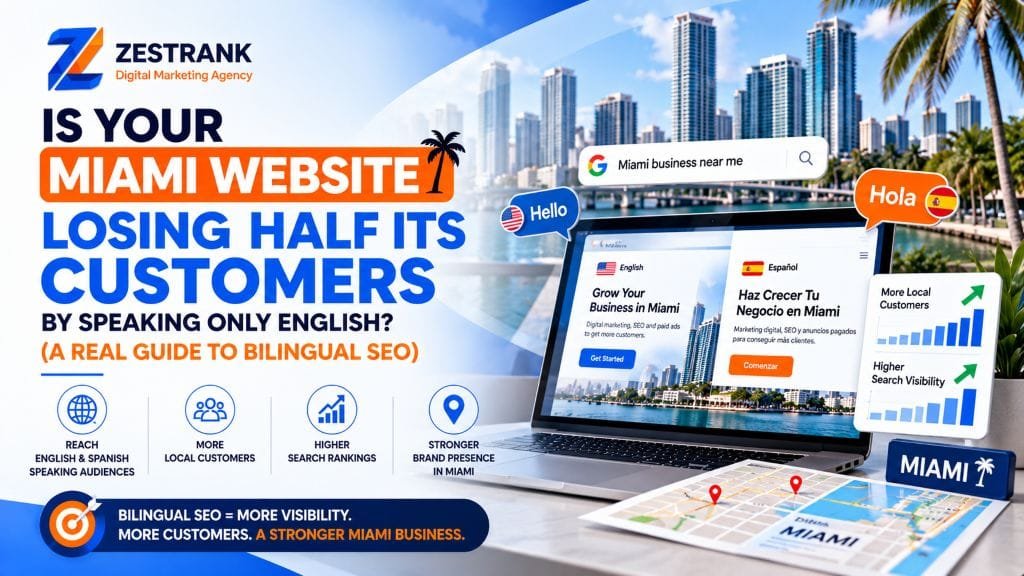
Quick answer: Miami search is bilingual, seasonal and international. A large majority of Miami-Dade residents identify as Hispanic or Latino, and visitors arrive from across Latin America, so an English-only site misses a big part of the market while a machine-translated Spanish copy underperforms. Doing it properly means researching real Spanish queries, writing natively, using language and region signals so Google shows the right page to the right person, and planning around Miami’s calendar: winter tourism, cruise traffic, Art Basel in December and hurricane season from June to November. Published US estimates for small-business SEO cluster around US$1,000 to $3,000 a month, with bilingual scope costing more.
A dentist in Kendall adds a Spanish page to her website. She runs the English text through a translation tool, publishes it and waits. Six months later it has almost no traffic. She concludes Spanish SEO doesn’t work in Miami. It does. What she built wasn’t Spanish SEO. It was a translated page, which is a different thing.
That’s the gap in most Miami SEO content. It says “add Spanish” as if it were a checkbox. In a city where language, culture and origin shape how people search, the details decide whether the page ever gets seen.
Why Does Machine Translation Fail in Miami? {#translation}
Three reasons, each of which you can see in your own search data.
Vocabulary varies by region. Spanish isn’t one set of words. A search from a Cuban American family, a recent arrival from Colombia or a visitor from Argentina can use different terms for the same thing. One translation can’t match all of them, and a tool will pick whichever its training data favored.
People mix languages. Searches like “dentista near me” or “abogado de accidentes Miami” are normal. Keyword lists built from translated English phrases miss them, while a list built from real Spanish autocomplete and search data catches them.
Trust signals differ. What a Spanish-speaking customer wants to see before booking, such as language support, payment options, community references and who will answer the phone, can differ from your English page. Translating the words without rethinking the content leaves those gaps open.
How Do You Actually Do Spanish-Language SEO? {#how}
- Research in Spanish first. Use Spanish-language autocomplete, People Also Ask and, if you have it, Search Console queries. Start from how people search, not from your English page.
- Pick the Spanish you’re writing for. Decide whether you’re addressing local Miami Spanish speakers, visitors from specific countries, or both. That choice affects vocabulary and examples.
- Write natively. A fluent writer who knows your audience should create or review the Spanish pages. Use machine translation, if at all, as a rough first draft.
- Don’t mirror English structure blindly. Questions, headings and calls to action may need to differ.
- Localise your profile. Replies to reviews, posts and descriptions in both languages help each audience see themselves in your listing. Our guide to getting more Google reviews covers building the review system.
- Keep business details consistent across both language versions: names, addresses, phone numbers and hours.
What Technical Setup Does a Bilingual Site Need? {#technical}
Search engines need to know which page serves which audience. Google’s guidance on managing multi-regional and multilingual sites explains hreflang annotations, which tell Google that an English page and a Spanish page are equivalents, and for which language and region each is intended. For example, es-US signals Spanish for United States users.
A few practical rules:
- Each language version should link to its counterpart, and the annotations should be reciprocal.
- Use separate, crawlable URLs for each language, such as
/es/, rather than swapping text with a script that search engines may not see. - Translate titles, meta descriptions, image alt text and structured data, not just body copy.
- Make sure a language switcher is visible and works on mobile.
If you’ve never audited this, our free SEO audit checklist and technical SEO mistakes guide cover common problems.
How Does Miami’s Calendar Change Search? {#calendar}
Demand in Miami follows a rhythm that’s easy to plan for and costly to miss.
| Period | What drives searches | What to prepare |
|---|---|---|
| Winter | Peak tourism: hotels, dining, attractions | Seasonal pages and fresh photos by autumn |
| Cruise days | Passengers before and after sailing: hotels, parking, transport, food | Pages answering port-related questions |
| Early December | Art Basel week: art, nightlife, hospitality, luxury services | Event pages eight to ten weeks ahead |
| June to November | Hurricane season: storm prep, roofing, shutters, repairs, insurance | Pages ready before the season starts |
Hurricane-related searches are urgent and high-intent. A roofing or shutter company that publishes a thorough preparation guide in May, in both languages, is far better placed than one that starts writing when a storm is on the news. After each wave, update or retire dated pages rather than leaving thin content live.
Does a Miami Business Need Neighborhood and Visitor Strategies? {#neighborhoods}
Brickell, Wynwood, Coral Gables, Little Havana, Doral, Kendall and Miami Beach (a separate city) have different audiences. Write for the ones you genuinely serve, using real detail rather than a template with swapped names. Also consider visitors: international tourists often search in their own language, and some look for businesses before they arrive, which rewards clear pages about location, hours, languages spoken and how to book.
If you’re in hospitality, see our SEO for hotels and resorts page. If you’re in property, where Latin American buyers are a major audience, see our SEO for real estate developers page. Our local SEO service page explains how we handle multi-area businesses.
What About AI Answers in Two Languages? {#ai}
People ask AI assistants questions in Spanish too. Run your own test. Ask ChatGPT, Gemini and Perplexity “mejor [category] en Miami” and “best [category] in Miami”, and note who gets named in each language. Results often differ, which means your visibility in one language doesn’t guarantee the other. Mentions on Spanish-language sites, directories and community pages matter as well as your own pages. Our AEO playbook explains the method, and our GEO guide explains how mentions influence answers.
What Does a Bilingual Example Look Like? {#example}
Imagine a Doral roofing company that serves both English and Spanish speakers. (Again, a hypothetical example.) Hurricane season is its busiest period, and most of its leads currently come from English searches. Here’s how a bilingual plan might work.
- Write the preparation guide twice, natively. The English version covers inspecting a roof before the season, what to document for insurance, and when to call a professional. The Spanish version isn’t a translation of that page. It starts from Spanish searches, where customers might use “techo”, “reparación de techos”, “huracán” or regional alternatives, and it reflects the questions Spanish-speaking homeowners actually ask.
- Give each language its own URL, such as
/es/preparacion-huracanes/, and connect the two versions with reciprocal hreflang annotations. - Reply to reviews in the language they were written in. It signals to each audience that someone is listening.
- Tag leads by language. Add a hidden field or call-tracking number per language so you can see which version produced each enquiry.
- Publish before the season. The guide should be indexed by May, not written when the first storm appears on the news.
How Do You Measure Bilingual Results? {#measuring}
Averaging English and Spanish together hides what’s happening. Track them separately.
| Metric | How to track it |
|---|---|
| Rankings and clicks by language | Search Console, filtered by page folder or language version |
| Calls by language | Separate tracking numbers or call-source tags |
| Form enquiries by language | A hidden “language” field on each version’s form |
| AI visibility by language | Monthly prompt tests in English and Spanish |
| Reviews by language | Count and respond to each in its own language |
If one language produces leads at a fraction of the cost of the other, you’ve learned where to invest next. If one produces nothing after a few months of proper work, check the research before blaming the market.
What Does SEO Cost in Miami? {#cost}
Published estimates come mostly from agencies and vary widely. Small businesses commonly see roughly US$1,000 to $3,000 a month. Bilingual work adds scope because the Spanish pages need their own research, writing and review, not a copy of the English effort. Ask for an itemised quote showing what’s included for each language, who writes the Spanish content, and how results are reported separately.
Can an India-Based Agency Do Bilingual Miami SEO? {#remote}
ZestRank is based in Noida, India, and works remotely. We don’t have a Miami office, and we aren’t native Spanish writers. For Spanish content, we’d expect your team or a fluent native writer to write or review the final copy, while we handle research, structure, technical setup and reporting. That’s a reasonable question to put to any agency: who exactly writes the Spanish? A 9am Eastern call lands in our early evening.
A 90-Day Plan for a Miami Business {#plan}
| Period | Focus |
|---|---|
| Days 1 to 30 | Audit the site and profile, run Spanish keyword research, check hreflang and URLs, set up tracking |
| Days 31 to 60 | Write native Spanish versions of the highest-value pages, localise the profile and reviews |
| Days 61 to 90 | Publish seasonal pages for the next wave, run bilingual AI prompt tests, compare results by language |
The Bottom Line
In Miami, language isn’t a feature you bolt on. Businesses that research Spanish queries, write natively and plan for the calendar reach customers their English-only competitors never see.
Want a bilingual SEO plan scoped to your business?
See our SEO services in Miami or book a free strategy session. For another competitive coastal market, see our New York City SEO page.
FAQs {#faqs}
Can I just machine-translate my website into Spanish?
It’s a starting point at best. Vocabulary varies by region and people mix languages when searching, so native review and Spanish keyword research matter.
What is hreflang and do I need it?
It’s an annotation that tells search engines which language or regional version of a page to show. If you run English and Spanish versions, it helps.
Should my Spanish pages have their own URLs?
Yes. Separate, crawlable URLs let search engines index each language properly.
When should hurricane-related content be published?
Before the season starts, so pages are indexed and ranking when urgent searches begin.
Is bilingual SEO more expensive?
Usually, because Spanish pages need their own research, writing and review.
Follow ZestRank on Google
Add ZestRank as your preferred source to see our latest SEO & AI search updates first in Google Search.
About the Author: Rohit Nandan
Founder & Lead Digital Marketing ConsultantRohit Nandan is ZestRank's Founder & Lead Digital Marketing Consultant and YouTube SEO Expert, with over 15 years of experience diagnosing and running search campaigns for businesses across Delhi NCR. He personally reviews ZestRank's client projects, with deep expertise in technical SEO infrastructure and YouTube optimization. Have a question about this post? Message Rohit directly on WhatsApp.
Free Consultation
Ready to see how these exact parameters can be configured to expand your physical business discovery indices?
Request Strategy Call WhatsApp Strategist
- Ultra-fast NVMe storage & LiteSpeed cache
- Free domain, SSL & daily backups
- Extra 10% off with coupon: 1ROHIT89
Starts at ₹139/mo* • 30-day money-back guarantee