What Is Parasite SEO? (And Why It’s Riskier Than Most “2026 Guides” Admit)

Rohit Nandan
Founder & Lead Digital Marketing Consultant
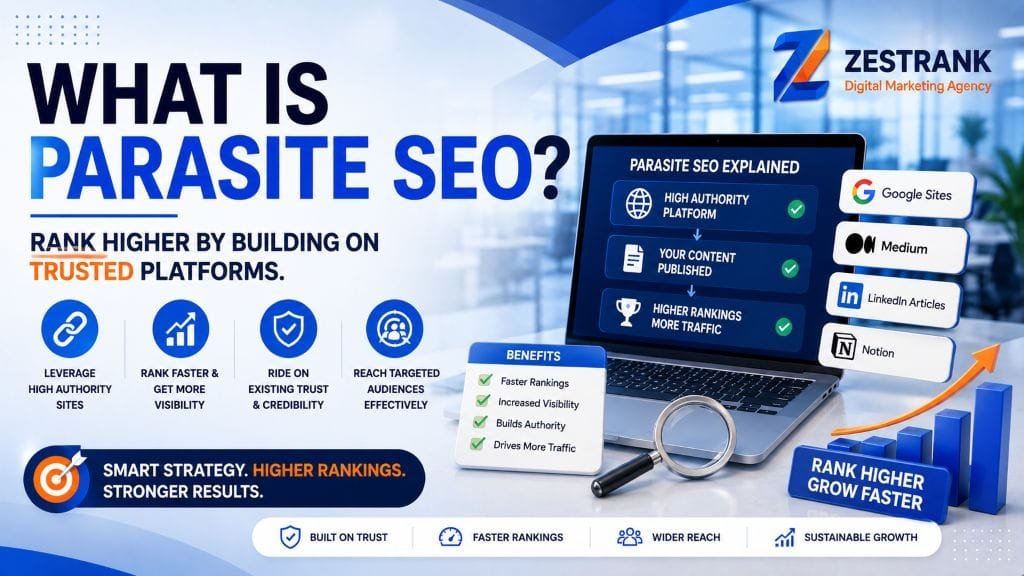
Quick answer: Parasite SEO is the practice of publishing content on a high-authority third-party website — a major news site, a free blogging platform, a forum — specifically to borrow that site’s ranking power and rank quickly for competitive keywords, rather than building your own domain’s authority. It used to be a genuinely effective shortcut. Since May 2024, Google has actively and repeatedly enforced a dedicated “site reputation abuse” policy against it, deindexing entire sections of sites as large as CNN, Forbes, USA Today, and Outlook India. As of 2026, it’s a high-risk tactic for anyone hosting the content, not a reliable growth hack — the practical opportunity today is understanding it well enough to avoid it, not to attempt it.
If you’ve searched “parasite SEO” recently, you’ve probably found a handful of guides explaining the concept, listing a few tactics, and closing with a soft “just be ethical about it” caveat. That’s roughly where the conversation stood in mid-2024. It’s not where it stands now. Here’s what’s actually changed, with real, named examples — and why that matters for anyone considering this tactic today.
How Parasite SEO Actually Works {#how-it-works}
The mechanism is straightforward: instead of publishing content on your own domain and waiting for it to build authority over months or years, you publish it on a domain that already has that authority — a major news outlet, a high-authority blog, a forum, a free publishing platform like Medium. Because search engines weight a domain’s overall trust and authority when ranking any individual page on it, your content can rank far faster and higher than it would on your own newer, weaker site.
Think of it as drafting behind a faster runner — you’re borrowing momentum you haven’t built yourself. That borrowed momentum is exactly what Google’s 2024 policy update was built to identify and remove.
The Gap in Most “2026 Guides”: What Actually Happened After 2024 {#enforcement}
This is the part almost no current parasite SEO content covers with real specificity, and it’s the single most important update to the topic in years.
In March 2024, alongside a core algorithm update, Google announced three new spam policies simultaneously: scaled content abuse, expired domain abuse, and site reputation abuse — the policy that directly targets parasite SEO. Google’s own definition, from its official Search Central announcement, describes it as third-party content published “with little or no first-party oversight,” where the purpose is to manipulate rankings by exploiting the host site’s existing authority — exactly the mechanism described above.
Enforcement began May 6, 2024, via manual actions (not just an algorithmic demotion) — meaning a real person at Google reviewed and penalized specific sites. Then, on November 19, 2024, Google tightened the policy further, removing an important carve-out: content that previously might have passed as acceptable because a host site’s editorial team had some oversight of it now counts as a violation too, if the underlying purpose is still to exploit the domain’s ranking power. Several older “parasite SEO explained” articles were written before this tightening and simply haven’t been updated to reflect it — a real currency gap worth knowing about if you’re relying on older content to understand the current risk.
Real Cases: Who Actually Got Hit {#case-studies}
Rather than a vague warning, here’s what actually happened — independently confirmed across multiple SEO news outlets (Search Engine Land, Search Engine Journal, Search Engine Roundtable) and Google’s own Search Liaison team on record.
| Site / Section | What Happened |
|---|---|
| CNN Underscored | Dropped to roughly 10 indexed URLs after a May 2024 manual action |
| Forbes Advisor | Entire sections deindexed, including its health content — reportedly stopped ranking even for the branded query “Forbes Advisor” itself after the November 2024 tightening |
| USA Today’s “Reviewed” | Significant organic traffic drops following enforcement |
| WSJ Buy Side | Deindexed alongside CNN Underscored in the same enforcement wave |
| LA Times, Fortune | Coupon directories stopped ranking for coupon-related keywords entirely |
| The Sun UK’s Shopping section | Lost visibility overnight |
| Outlook India, TimesUnion, Post and Courier, SFGATE | Parasite directories fully deindexed — proof this wasn’t limited to only the largest US publishers |
Outlook India’s inclusion is worth sitting with if you’re evaluating this for an Indian business specifically: this isn’t a US-only enforcement pattern. Google applied the same policy, the same way, to a major Indian publisher.
Reports at the time estimated Forbes alone lost several million dollars in traffic value from a single enforcement wave — and notably, Google timed a major round of these actions just days before Black Friday and Cyber Monday 2024, the highest-value shopping period of the year for exactly the kind of coupon and deal content parasite SEO was being used for.
Types of Parasite SEO {#types}
The tactic shows up in a few recognizable forms:
- Guest posts and sponsored content on major sites, often disclosed only faintly or in an easy-to-miss location
- Free blogging platforms (Medium, WordPress.com, Blogger) used purely as a ranking vehicle rather than a genuine publishing home
- Forum and community posts with strategically placed backlinks
- Review or “best of” sections hosted on a news site’s subdomain but operated by a third party
- Wikis and user-generated platforms where editorial oversight is minimal
Not everything in this list is automatically a violation — the distinguishing factor Google actually evaluates is purpose and oversight, not simply “was this published somewhere other than my own domain.”
Is Parasite SEO the Same as Black Hat SEO? {#black-hat}
Not automatically — and this is a genuinely useful distinction most guides blur. Legitimate guest posting and digital PR, where you contribute genuinely valuable, disclosed content to a relevant publication with real editorial involvement, isn’t what Google’s policy targets. What it targets is content published specifically to exploit a domain’s authority for rankings it wouldn’t otherwise earn — thin, unrelated, template-driven, or minimally-overseen third-party content riding on a host’s trust.
The practical test: if the content would still make sense on that platform if it couldn’t rank well from it — if it exists there because it’s genuinely relevant to that audience, not because that domain ranks well — it’s much more likely to be legitimate. If the placement only makes sense because of the domain’s authority, that’s the pattern Google is now actively enforcing against.
Does Parasite SEO Still “Work” in 2026? {#still-work}
For the core goal — ranking in traditional Google organic results on a host domain — the honest answer is: increasingly no, and the risk of a manual action has grown, not shrunk, since 2024. Independent 18-months-later analyses of the policy’s enforcement found Google has continued applying it, with the clearest risk sitting on content that’s fully third-party-operated rather than genuinely produced or closely overseen by the host site’s own team.
There’s one genuinely new wrinkle worth knowing for 2026 specifically, and it connects directly to the broader shift covered in our piece on how AI search changed what “ranking” even means: some SEO analysts have observed deindexed parasite content still appearing inside Google’s AI Overviews even after being manually removed from standard organic results — a gap between how Google’s classic ranking system and its AI-generation layer currently treat the same content. This isn’t a reliable loophole to build a strategy around — it’s inconsistent, likely temporary, and doesn’t change the underlying penalty risk to the host site. But it does illustrate a broader 2026 reality: ranking and AI citation are increasingly two different systems, a theme we cover in depth in our Generative Engine Optimization (GEO) guide.
How to Check If You’ve Been Affected {#check}
If you host third-party content on your own domain — a coupon section, a “sponsored reviews” subdirectory, contributor content with light oversight — it’s worth a direct check:
- Check Search Console’s Manual Actions report for any “Site Reputation Abuse” notice.
- Search your own branded terms for the affected section (e.g., “[yoursite] coupons,” “[yoursite] reviews”) and confirm it’s still appearing as expected.
- Categorize your third-party content honestly: is it host-produced, third-party content with genuine close editorial involvement, or fully third-party-operated with minimal oversight? The third category carries the most risk under the current policy.
- If you find a violation, Google’s own guidance is direct: noindex or fully remove the affected content — a robots.txt block alone does not satisfy this for already-indexed HTML pages.
The Sustainable Alternative {#alternative}
If the appeal of parasite SEO was speed — ranking faster than building your own domain’s authority allows — that underlying need is real and worth solving properly rather than through a tactic actively being penalized. A few approaches address the same goal without the risk:
- Genuine digital PR and guest contribution, where you add real value to a relevant publication with proper disclosure, rather than using it purely as a ranking vehicle
- Building topical authority on your own domain through genuinely thorough, well-structured content — the same approach covered in our On-Page SEO Checklist
- Investing in off-site brand mentions (reviews, community discussion, third-party citations) rather than borrowed domain authority — this is increasingly what actually drives AI citation too, as we cover in our Answer Engine Optimization playbook
None of these are as fast as parasite SEO once was. All of them are durable, and none carry the risk of a manual action wiping out your visibility overnight, days before your busiest season, the way it did for Forbes Advisor in November 2024.
Final Thoughts
Parasite SEO is a good example of a tactic the SEO industry hasn’t fully caught up on describing accurately. It wasn’t a myth in 2020 — it genuinely worked, and some of it still technically functions in narrow, high-risk pockets. But treating it as a viable current strategy without accounting for two full years of active, well-documented, high-profile enforcement — against sites with far more resources to manage the risk than most small businesses have — is giving readers an outdated picture of the actual trade-off.
Want a sustainable SEO and AI-visibility strategy that doesn’t carry this kind of risk?
ZestRank builds SEO strategies around genuine domain authority, content depth, and — increasingly — AI search visibility through our AI Search Optimization service, rather than tactics that Google has spent two years actively dismantling. Book a free strategy session if you want to know what durable ranking growth actually looks like in 2026.
FAQs {#faqs}
Is parasite SEO illegal?
No — it’s not illegal, but it violates Google’s Webmaster Guidelines and site reputation abuse policy specifically, which can result in manual actions, deindexing, and significant traffic loss for the hosting domain.
Can a small business get penalized for parasite SEO the same way Forbes or CNN did?
Yes, and arguably with less room to recover — large publishers had other revenue streams and traffic sources to absorb the hit. A small business relying heavily on a single ranking section built this way has far less cushion if that section is deindexed.
Is guest posting the same thing as parasite SEO?
Not inherently. Genuine guest posting with real editorial value and proper disclosure is broadly accepted. Parasite SEO specifically describes content whose primary purpose is exploiting a host domain’s authority rather than genuinely serving that platform’s audience.
Did Google’s site reputation abuse policy only target large news publishers?
No — while the highest-profile cases (CNN, Forbes, USA Today) were large publishers, the enforcement also hit mid-sized and regional sites like Outlook India, TimesUnion, and Post and Courier, confirming the policy applies broadly, not just to major US media brands.
Does parasite SEO still show up in Google’s AI Overviews even after being deindexed?
Some SEO analysts have observed inconsistent cases of this happening, since AI Overviews and traditional organic indexing don’t always update in perfect sync. It’s not a reliable loophole and doesn’t change the underlying penalty risk to the hosting domain.
About the Author: Rohit Nandan
Rohit Nandan is ZestRank's Founder & Lead Digital Marketing Consultant and YouTube SEO Expert, with over 15 years of experience diagnosing and running search campaigns for businesses across Delhi NCR. He personally reviews ZestRank's client projects, with deep expertise in technical SEO infrastructure and YouTube optimization. Have a question about this post? Message Rohit directly on WhatsApp.
Free Consultation
Ready to see how these exact parameters can be configured to expand your physical business discovery indices?
Request Strategy Call WhatsApp Strategist