SEO vs PPC for Small Business: Which Should You Fund First in 2026?
Rohit Nandan
Founder & Lead Digital Marketing Consultant
Quick answer: For most small businesses in India, PPC is the faster route to your first leads (results within days, average Google Search CPC of ₹24–₹60), while SEO builds a cheaper, compounding lead source over 4–8 months. If you can only fund one channel today, base the choice on how many months of runway you have — not on which channel is “better.” Most businesses that grow past their first year end up running both, shifting spend from paid to organic as rankings mature.
If you’re a small business owner in Delhi, Noida, Gurugram, or Ghaziabad deciding where your first digital marketing rupee goes, this is the question that actually matters: SEO or PPC? The honest answer is that they solve different problems on different timelines, and the right split depends on your runway, your industry’s ad costs, and how competitive your keywords already are.
What Is SEO?
SEO (Search Engine Optimization) is the practice of improving a website’s content, structure, and authority so it ranks higher in Google’s unpaid (“organic”) results. Once a page ranks well, it can keep generating clicks for months or years without paying per visitor — though it needs ongoing content and technical maintenance to hold that position as competitors and Google’s algorithms both keep moving. SEO includes technical fixes (site speed, mobile usability, indexability), content built around what people actually search for, and building the authority signals — links, mentions, reviews — that tell Google a page deserves to rank. If you’ve heard SEO is losing relevance because of AI search, it’s worth reading why SEO isn’t actually dying — the channel is changing, not disappearing.
What Is PPC?
PPC (Pay-Per-Click) advertising, most commonly Google Ads, lets you pay to appear at the top of search results immediately for keywords you choose. You’re charged per click, not per impression, and traffic stops the moment your budget or campaign pauses — there’s no lingering benefit the way there often is with SEO. The upside is speed and precision: you can target a specific city, a specific device, a specific hour of the day, and see results the same day you launch.
Direct Comparison: SEO vs PPC
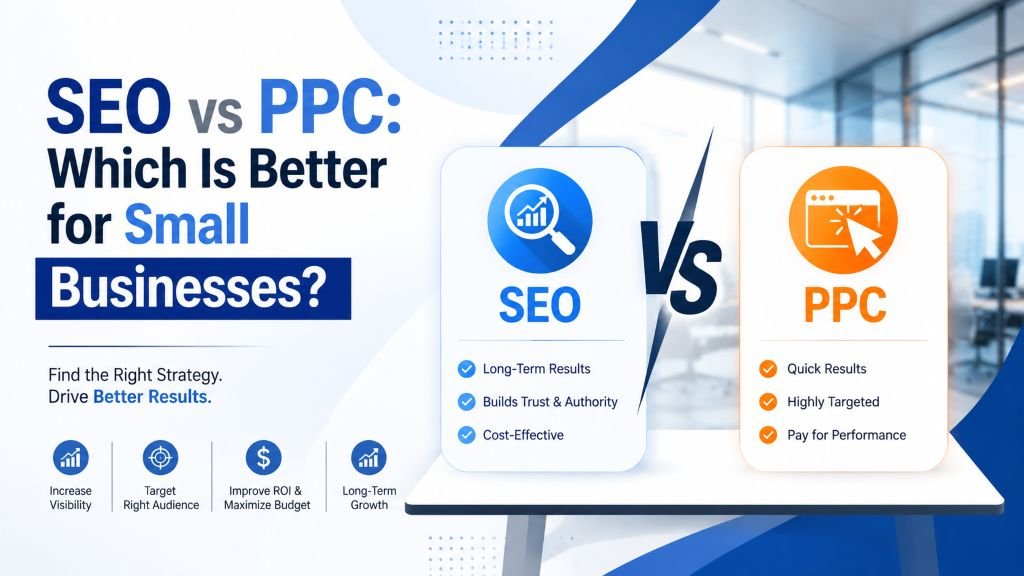
| Factor | SEO | PPC |
|---|---|---|
| Time to first results | 4–8 months typically | Same day |
| Ongoing cost | Lower once ranking is established, but not free | Continuous — stops the moment budget stops |
| Typical India cost | Content + technical work; agency retainers commonly ₹15,000–₹75,000/month for small business SEO | ₹24–₹60 average CPC on Search; local-service categories often ₹10–₹60, competitive B2B/finance ₹150–₹600+ |
| Longevity | Can persist for years with maintenance | Disappears the moment spend stops |
| Control over messaging | Limited — Google decides the snippet and format | Full control over ad copy, offer, and landing page |
| Targeting precision | Broad — ranks for what content covers | Precise — city, device, time of day, audience |
| Best for | Sustainable, compounding growth | Urgent leads, testing offers, new websites |
What SEO and PPC Actually Cost in India (2026)
This is the part most comparison articles skip, and it’s the number that should drive your decision.
PPC cost: The average cost-per-click for Google Search ads in India in 2026 sits around ₹24–₹60, but the real range is wide — roughly ₹5 at the cheap end to ₹600+ for high-value categories like legal, insurance, and B2B SaaS. Local service businesses (salons, clinics, repair services, plumbers) typically pay ₹10–₹60 per click. A realistic starting budget for a small business is ₹15,000–₹50,000 per month in ad spend, plus management if you’re not running it yourself. If your CPC already feels too high, see our guide on how to reduce CPC on Google Ads before assuming the channel isn’t working.
SEO cost: SEO doesn’t have a per-click price tag — you’re paying for content production, technical fixes, and ongoing optimization. For a small business in Delhi NCR, that typically means an agency retainer, an in-house content budget, or a mix of both, sustained over months before rankings mature enough to produce consistent leads. See our SEO packages and pricing in Delhi for a realistic sense of what that looks like.
The practical implication: if your industry has expensive clicks (finance, legal, real estate, high-ticket B2B), the cost math tips toward SEO earlier, because every PPC click is expensive whether or not it converts. If your industry has cheap clicks (local services, food, low-ticket retail), PPC can be efficient to run for far longer, and there’s less urgency to rush SEO.
When SEO Makes More Sense
- You’re building for the next 1–3 years, not just the next quarter
- Your category has consistent, non-seasonal search demand
- Your industry’s Google Ads clicks are expensive (₹150+), so paid leads eat margin fast
- You want a lower cost-per-lead once rankings are established
- You’re willing to invest in content and technical SEO without an instant payoff — see how long SEO actually takes to show results in India before you commit
When PPC Makes More Sense
- You need leads or sales now — a new business with no existing traffic, a seasonal promotion, a launch
- You want to test which keywords, offers, or messaging convert before committing months of content around them
- Your website is new and hasn’t built organic authority yet
- You’re in a keyword space so competitive that ranking organically could take a year or more
- Your industry has cheap clicks (₹10–₹60), making paid leads genuinely affordable
New to paid search entirely? Start with our Google Ads for beginners guide. And if you’re also weighing Meta’s ad platform, see Google Ads vs Facebook Ads for how the two compare.
Which Channel Fits Your Type of Business
Local service business (salon, clinic, repair, home services): Start with local SEO and a Google Business Profile — this category typically sees the cheapest PPC clicks too, so a modest ad budget alongside SEO works well from day one.
E-commerce: PPC (Search + Shopping ads) usually earns its keep fastest because purchase intent is immediate; layer in SEO for category and product pages once you have traffic data showing which searches actually convert.
B2B or high-ticket services (finance, legal, real estate, consulting): Clicks are expensive here, so SEO’s compounding cost-per-lead advantage matters more — but don’t skip PPC entirely, since a small, tightly targeted campaign is useful for testing which offers convert before you invest months in content.
New brand with zero existing traffic: PPC first, always — there’s no organic authority to lean on yet, and you need data on what converts before writing SEO content around it.
Why Most Businesses Should Use Both
The smartest approach isn’t choosing one — it’s sequencing them and shifting the ratio over time:
- Start PPC immediately to generate leads while your SEO foundation is being built.
- Use PPC data to inform SEO — the keywords and ad copy that convert well in paid search are a strong signal for which organic content to prioritize.
- Shift budget toward SEO gradually as rankings mature and you need paid spend less for the same keywords.
- Keep some PPC running for high-intent, high-competition terms where ranking organically may never be fully reliable.
A rough starting split by business stage:
| Stage | PPC Share | SEO Share | Why |
|---|---|---|---|
| Month 0–3 (no traffic yet) | 80% | 20% | You need leads now; SEO hasn’t had time to work |
| Month 4–9 (early rankings appearing) | 60% | 40% | Organic starts contributing; keep paid for volume |
| Month 10–18 (rankings maturing) | 40% | 60% | Organic carries more weight; trim paid spend |
| Month 18+ (established rankings) | 20–30% | 70–80% | SEO does the heavy lifting; PPC covers gaps |
Treat these as a starting point, not a formula — a business in an expensive-CPC industry will want to shift toward SEO faster than this table suggests. For a real example of what the SEO side of this shift can look like once it compounds, see our case study on a 410% organic growth result.
Common Mistakes Small Businesses Make
- Judging SEO after 6 weeks. Meaningful organic movement typically takes 4+ months; judging too early leads to abandoning a channel right before it would have paid off. See our full list of SEO mistakes we see most often in Delhi.
- Running PPC with no landing page built for conversion. Sending paid traffic to a generic homepage instead of an offer-specific page wastes a large share of ad spend — this is one of the most common reasons a PPC campaign isn’t converting.
- Picking one channel permanently instead of sequencing. The businesses that struggle most are usually the ones that treat this as a once-and-for-all decision instead of revisiting the split every quarter.
- Ignoring cost-per-lead by keyword. Not every keyword is worth the same CPC — a ₹40 click that converts at 1% can cost more per lead than a ₹90 click that converts at 5%.
- No tracking on either channel. Without conversion tracking (calls, form fills, WhatsApp messages), it’s impossible to know which channel — or which specific campaign or page — is actually working. WhatsApp is a large enough lead channel in India on its own that it’s worth reading how to run WhatsApp Business marketing alongside SEO and PPC.
How to Measure Whether Either Channel Is Working
For PPC: track cost-per-click, conversion rate, and — most importantly — cost-per-lead and cost-per-customer. A cheap click that doesn’t convert is more expensive than an expensive click that does.
For SEO: track ranking positions for your priority keywords, organic traffic to money pages (not just the whole site), and — again — leads generated from organic, not just visits. Traffic without leads isn’t progress.
Google’s own guidance on how Search ranking works is a useful primer if you want to understand what you’re actually being judged on before investing in either channel.
A Simple Way to Decide If You Can Only Afford One
Ask two questions:
- How soon do I need revenue? If the honest answer is “this month,” start with PPC.
- What does a click cost in my industry? If it’s ₹150+, the cost math favors building SEO sooner rather than running PPC indefinitely.
If you’re building for next year and beyond, have the patience to invest without immediate payoff, and your category’s clicks are expensive, prioritize SEO. Most businesses outgrow the either/or framing within 6–12 months and end up running both in some proportion.
Final Thoughts
SEO and PPC aren’t competing for your budget — they’re complementary tools solving different problems on different timelines, and both keep evolving alongside broader digital marketing trends in India. The businesses that grow fastest in Delhi NCR’s competitive market don’t pick one permanently; they use PPC for speed and SEO for sustainability, and adjust the mix as their organic presence matures and their industry’s ad costs change.
Not sure how to split your budget?
ZestRank is a full-service digital marketing agency in Delhi NCR offering both SEO services and PPC/Google Ads management — including dedicated local SEO for businesses in Delhi, Noida, Gurugram, and Ghaziabad — so we can recommend the mix that’s actually right for your business, not just sell you whichever service we specialize in. Not sure who to trust with either channel? Read what to ask before hiring a marketing agency in Delhi first. Or start with a free SEO audit checklist and our free SEO tools to see where your site stands today. Book a free strategy call and we’ll map out a realistic plan based on your budget, timeline, and industry.
Frequently Asked Questions
Is SEO cheaper than PPC in the long run?
Generally yes, once a page achieves a strong organic ranking, since you’re not paying per click for that traffic. It’s not free, though — SEO requires ongoing content and maintenance investment to sustain rankings, just structured differently than PPC’s pay-per-click model.
Can I pause SEO the way I can pause PPC?
You can stop actively investing in new SEO work, and existing rankings may persist for a while, but they typically decline gradually as competitors keep optimizing and Google’s sense of “current best” content evolves. PPC traffic stops almost immediately when paused.
Which is better for a brand-new website with zero traffic?
PPC, for immediate visibility — a brand-new website has no existing authority to rank organically yet. Many businesses run PPC for the first several months while SEO builds in parallel.
Does running PPC help my SEO rankings?
Not directly — Google has confirmed ad spend doesn’t influence organic rankings. However, PPC campaigns generate keyword and conversion data that can sharpen your SEO content strategy considerably.
What’s a realistic monthly budget to start with in India?
For PPC, ₹15,000–₹50,000/month is a workable starting range for most local and small-to-mid service businesses, adjusted up for expensive-click industries like finance or legal. For SEO, budget for a sustained commitment — a few months of content and technical work — rather than a one-off project, since rankings build cumulatively.
How do I know if my Google Ads cost-per-click is reasonable for my industry?
Compare it against your category, not a national average — local services in India commonly run ₹10–₹60 per click, while finance, legal, and insurance regularly exceed ₹150–₹600. A click that looks expensive in isolation can still be profitable if your customer lifetime value supports it.
Have a question about this post? Message Rohit directly on WhatsApp or book a free strategy call. For more breakdowns like this, browse the ZestRank blog, or learn more about our team.
About the Author: Rohit Nandan
Founder & Lead Digital Marketing ConsultantRohit Nandan is ZestRank's Founder & Lead Digital Marketing Consultant and YouTube SEO Expert, with over 15 years of experience diagnosing and running search campaigns for businesses across Delhi NCR. He personally reviews ZestRank's client projects, with deep expertise in technical SEO infrastructure and YouTube optimization. Have a question about this post? Message Rohit directly on WhatsApp.
Free Consultation
Ready to see how these exact parameters can be configured to expand your physical business discovery indices?
Request Strategy Call WhatsApp Strategist